Saturday, 16 February 2013

Bring Your Own Device in schools - an implementation strategy Part 2

I blogged a little while ago about the journey we are taking in our school to implement a SMART Learning strategy, facilitated by a scheme allowing students to bring their own devices to the learning environment. We've been through the exploration phases, the feasibility stage, and the infrastructure set-up stage in that post, so forgive me if I don't go into it again. Read it for yourselves, I can't be bothered to type it all out again, I'm on holiday, and I've given you enough repetition of the same hyperlink in the last sentence that you can't miss it!

Developing an Acceptable Use Policy:

At the time of writing it we were on the verge of conducting a school-wide Safer Internet Day project, most ably led by my co-conspirator @Gripweed1 (definitely worth following). The lesson was conducted by all mentors across all students, and Associate Staff and SLT were attached to classes too, so it was genuinely a school-wide discussion. The theme was the rights and responsibilities of using digital devices and the internet, both inside and out of school, and the ultimate aim was to engage the students in defining what would become our Acceptable Use Policy. The responses we got from students were very high quality, with a great deal more emphasis on the responsibilities they had than the rights, and a lot of intelligent discussion about where one person's rights conflicted with those of others. The results were presented in assemblies to each college by the ICT students leaders, so the students could see what we had done with their input, and we are now hoping to run a more focused Baraza*-style consultation of the students to focus their ideas down into a simple, user-friendly policy which achieves their buy-in.

* Baraza: noun, of African origin: To sit round in a village circle and have a chat about making the village a better place in order to hit FFTD targets, or something like that. I don't know. Head's idea, but works really well

Now, however, we reach the squash stage: There are a number of simultaneous processes we have to carefully carry out at the same time, but without any of them getting too far ahead of the others, lest the whole thing falls apart. The key stake-holders are all involved in these stages, because to put it simply:

  • We can't switch on unrestricted access to wifi until we have students agreeing to how it will be used
  • We can't allow students to use their devices willy-nilly (stop me if I get technical) without showing them how to use them responsibly in an educational context, to assist their learning
  • We can't teach them how powerful these tools are for learning unless we have teachers trained in the use of SMART devices and pedagogy
  • We can't expect the teachers to also be trained up in the potential technical problems associated with different devices, so we have to train up digital leaders to assist in technical matters
  • And we can't do any of this without the rationale for it being clear to the parents themselves, who are otherwise quite within their rights to wonder how their children can learn in a class where they are allowed mobile devices out when these very same devices are exactly what prevents them getting any form of decent conversation out of their offspring once they get home at night!!
You get the idea. Lots of people to get on-board, lots to work out in terms of the order in which to do this. So this is our priority list:

Digital Leadership training:

Before students start using the devices for learning, the teachers need to be ready to use them, and need to be able to overcome a range of technical obstacles in their way. You may be lucky enough to have a great team of techies in your school to be able to help out with this, but frankly, even with the best will in the world, once there are 1500 plus devices around the place, they're in it way beyond their eye-balls. Our strategy is to train a crew of digital leaders across all years whose job it will be to assist in two key ways:
  1. With basic device problems, functionality, logins, printer problems etc
  2. With helping the teachers source ideas for using the new technology in learning
If we can get at least one digital leader in every classroom across each year, the teacher hopefully shouldn't need to worry about stopping the entire lesson because "Sir, my phone's not working!" The teacher will have enough on their plate without having to worry about that, and moreover, the less confident a teacher is, the fewer obstacles it will take before they jack it all in as unworkable, new-fangled etc etc. The role of digital leaders is to shoulder those technical responsibilities, and that will take a lot of training.


Staff Training:

Our next stage in our school is to get a group of digital enthusiasts together to lead the initiative further. We could call these "dangerous teachers". We could equally call them "canon fodder" I guess, but let's stay positive! These need not, and ideally should not, be tech-experts. Restricting this part of the project to the tech-savvy will alienate anyone else too easily, and make it seem like a clique of "boys with toys", at the risk of stereotypical gender generalisation. Better to have a cross-curricular range of gifted enthusiastic amateurs who know the potential, and want to develop it.

Staff who are developing new pedagogies need time to experiment and explore. That would go for any new idea, whether it be co-construction, SOLO Taxonomy, Flipped learning or whatever. All the more so for SMART Learning. Not only do they need time to get to grips with a device, but they then need time to work out how it fits into their curriculum, what the potential for it is. Mark Anderson (@ICTEvangelist) has written some superb guidance on how to move mobile device use through a variety of stages from the enhancement of teaching to its transformation, and teachers who are taking on this challenge will have to work their way gradually through these stages to get the best out of them.

In a BYOD environment, teachers wil initially be looking at web-based tools which anyone can access no matter what device, and then be looking at more specific apps for certain tasks, some of which may be exclusive to certain platforms. At the moment, there are a great many apps I use on iPads which are simply not available on Android, but others may be, and teachers will go on to explore those, as well as eventually looking at subject-specific apps. All of this takes time and regular training, which is why the teachers shouldn't also have to worry about the technical side of things going wrong, hence the digital leadership programme.

Once the teachers feel comfortable with their devices, and their potential, it can easily be made part of those digital leaders' remits to ask what departments' needs are, and to find possible solutions to present to the teachers, almost reversing the teacher-student relationship.

For me, this is one of the most crucial areas of staff training: To get them to accept that in a fast-moving, hi-tech world, they are no longer the "sage on the stage". If teachers have the humility to accept that they may not know something, but that by working with students there will be a way to find out, they will establish strong collaborative relationships which could mark a fundamental shift in the way students see the relationship too. When students and teachers are brought down to the same sort of level, the focus on learning and progress becomes much sharper, with both parties constantly interrogating the path they're taking, and the tools they're using.

We also need to get away from the idea of "safe teaching". All teaching should be inherently dangerous, and perhaps uncertain, but if the final destination is something which is agreed from the start, collaboration will get us there in the end. Hopefully this will pave the way for a far more risk-taking culture, and it requires a brave leap of faith from leadership teams to allow their staff to try to fly, and watch them occasionally fall. But in the words of one of my favourite philosophers...
"Why do we fall? To pick ourselves up." Might be a prize for guessing the philosopher. Leave your guesses in the comments section...

Class Trials:

So after the digital leaders are trained, the next stage is class trials led by those "dangerous teachers". This would involve allowing teachers to experiment, try different ideas with different classes, getting digital leaders alongside them each step of the way, meeting regularly to discuss new needs until the staff are completely comfortable, at which point the digital leader roles can be extended even further to include pedagogical questions, such as "what works best if we are trying to...?". You can see we're not talking about an overnight process here. In my opinion, if you don't give SMART learning the time to bed in, and support it with a long-term development strategy, it will not become an effective tool in the learning toolbox.

Once those classes, teachers and digital leaders feel comfortable in their roles, and have ironed out a lot of the worst potential pitfalls, then you can start bringing the rest of the staff onboard, training them in exactly the same way.

Eventually you want to get to a stage when the technology is a non-issue. It's invisible. Its use is seamlessly integrated into classrooms in a way which enhances learning, but doesn't get in the way of learning. The same is true of behaviour problems which devices may seem to be causing. Students need to be trained into a routine of how to use mobile technology effectively to assist their learning, but if they do misuse it (for Facebook, games, texts etc), then what you have is a behaviour issue, which should be challenged as such. Part of our job as teachers is to show students that there is another way to use this type of technology, beyond the recreational. And as one BYOD enthusiast told me once, students disengaging with lessons on their mobile phone are often much easier to spot than those who are quietly simply staring out of the window. Either way, they need to be engaged in the learning process, and that's our job.

Next instalment: Parental engagement. How to sell your idea for SMART learning to get parental support for it. They're the ones paying for the devices, after all...


For anyone interested, this is an outline of our strategy and rationale at Finham Park:


Finham Park School SMART Learning implementation strategy


Monday, 11 February 2013

Simple ways to use iPads in lessons

So a few weeks back I blogged about a lesson we'd done using the iPads, and tried to give the impression it happened every lesson when clearly it doesn't! Fraud that I am, I got away with it, to the tune of nearly a thousand hits apparently. Next step: To set up my own religion.

I got several nice comments, and realised that a few people were interpreting this as a failsafe lesson using iPads, which wasn't quite the way I'd intended it. It worked for those students at that time of day. My point about iPads is really that they enhance learning if used as a tool, and in the same way that there are thousands of ways to skin a cat (or eat a horse apparently!) when it comes to teaching a lesson, so the variety of ways in which an iPad can be used is likewise pretty much infinite. Today, I tried another way...

Stage One:

We started the lesson with a quick Socrative quiz to see if we could establish prior learning about some of the concepts they would be encountering during their unit on representations across different media platforms, which yielded surprisingly little. Spot check number one told me I needed to cover the basic concepts and get some definitions first...

Stage Two:
We then divided the class into random groups of four using a fab little app called RandomMaster: I've pre-entered the students' names in there, and it simply randomizes them as necessary, in front of their eyes on the AppleTV, and there's no arguing, and no bloody lollipop sticks! Into groups they go, which they're more than used to by now, and to each group I assigned Expert status. I assigned each group to research and define two key terms for the rest of the class (though I didn't tell them who would be presenting the definitions), and emailed them a variety of documents which were differentiated to help with their tasks, though they were free to search for additional or corroborative material on the internet. One student I kept out of the fray. She is one of the bright ones in the class with a knack for clear, student-friendly explanations, so I gave her the job of putting together the final document which we would share as a result of the lesson. While the students were researching and formulating their ideas and definitions, she was preparing to put the final document together by interrogating each group's ideas, working out if she could understand them, asking questions if she couldn't understand etc. All in all, it helped her clarify her thinking and theirs, by getting rid of some of the vaguaries that they are prone to settling for in Year 10.

Stage Three:
Another random selection picked out the people to present their definitions to the class, and off they went. Some good, some not so good. Time for another little cool app: Traffic Light! A nifty simple little app that lets students tell me whether they understand or not immediately. If they don't, I want a question out of them. Several questions later we had refined the definition, addressed several misconceptions, and had a class full of greens: Huzzah and hurrah, as the writers of Blackadder would have said. We can move on. Our basic concepts covered, my assisting student finalised her note and tweeted it to the class using Evernote, and they then simply integrated it into one of their own notes for the lesson. Evernote is another of those fabulous apps which has been spread ad infinitum on Twitter, but for those of you unaware of its fabulousness and potential, here are a few of the basics it does superbly:

  1. Cloud-based apps, accessible on any device which connects to the internet
  2. Note-taking can be done through typing or dictation
  3. Pictures from the computer, camera roll or camera itself can be fully integrated, as can audio recordings, word documents, PDFs...
  4. Notes can be shared across a variety of platforms, including Twitter, and then integrated into your own notebooks
  5. Notes can be put into specific notebooks to help organisation, or tagged to appear when searching for a number of different topics
And that list comes nowhere near doing it justice.

Stage Four:
Extended learning work: Each student has to exemplify one of the key concepts we've just defined to show how well they understand it, by finding an example and analysing it. They are helped with cue questions which are differentiated so as to provide writing frames for some, and extension questions for others, and again these are emailed out to the whole class. They choose which resources will help them most effectively. Students undertake the task using whatever apps they feel work best for them, and today they went for a variety, from Evernote to Popplet to Explain Everything, all of which I have blogged about elsewhere, and all of which allowed them to show learning in a way which suited them individually. Did they all make progress? Certainly. Was it an easy lesson to set up? Yes. Once the students are used to the tools, I'm finding this sort of thing gets easier and easier as we go, as does the ability to change course in the middle of the lesson. And at every stage, the variety of AfL tools available help me ensure that nobody is hiding, and that everyone has to understand. A quick Socrative plenary, an Exit Ticket today (single thunk question to test the depth of their understanding, plus a feedback mechanism telling me how well the students feel they managed to understand the material themselves), and I'm ready to diagnose the answers quickly, and plan the next lesson...

For anyone interested, here are a few quick tutorials about some of the software mentioned above. If it's not here, it's so easy my mum could work it out!


Socrative tutorial


Popplet tutorial


Explain Everything - Forgive the video: Boring I know.


Saturday, 2 February 2013

Bring Your Own Device in schools - an implementation strategy Part 1

Forgive me in advance, this might be a long one. Cartoon at the end for your efforts? Deal...

The following describes our arrival at a scheme for deploying SMART Learning across our school, a scheme to use mobile devices as a learning tool. But it might need some context first. Quite a lot of context actually. Bear with me...

(Quite a lot of) Context

As part of our ideas for moving the school I work in beyond its current "Outstanding" I have undertaken a project as part of my ASLDP course. We were asked to identify "gaps" at the start of our course, which we would have to close with a whole-school project. This isn't so much a gap as an area where students cannot always move beyond at present. We have really good, keen students in general, but very often they are not as independent as we want them to be. There is some excellent practice across the whole school, but not consistency. One of the things we are hoping to achieve is a level of student autonomy and independent thinking which will free them up to work at their own pace, to their own potential.

I've talked about the idea of "flipped learning" before, as it caught my eye a year or more ago. While I don't subscribe exclusively to Salman Khan's methods, I think the principle of getting students learning content at home and putting it into action in class is a sound one, as it allows the teacher to look at how well learning is applied, and to address misconceptions more individually, and more quickly, thus keeping students all moving forwards, albeit at a pace which is appropriate to them. I also think the idea of using videos is a good one for many students, but I'd be foolish if I told you it was the only way to do it (and who am I to tell you I'm not a fool, eh?). Some students work much better from reading material, others from videos, with examples and short tests, while others prefer something more auditory like a podcast.

At the same time I have been exploring the fantastic opportunities to work with iPads in my classroom, and I could see immediately the potential they had for integrating with flipped learning and enhancing it further. My early attempts were limited, but at least I could see the potential, so I started using the iPads in class, and invested in them within the department so that each student could have one whenever they were in my class. This has been a huge step forward, as the quasi-ownership of the devices has allowed students to store some work on there, but there are limits to this when other students come in for the next class, and want to use the same apps. Sign the last student out, sign yourself in, yada yada, faff faff faff. Not a good use of "bell work". Ownership is definitely key when it comes to using mobile devices in schools, so it soon became apparent that we would need to get a device into the hands of every student if we were to move this forward. We started talking about iPad roll-outs, leasing schemes, BYOD, and pretty soon were lost in device considerations, and getting into pointless Android vs iPad vs Microsoft Surface (obviously that last is a joke) arguments. At the end of it all, we've had to remind ourselves that the learning is the key goal here, so our iPad or BYOD scheme ideas have now given way to SMART Learning (© Jason our fab techie)...

SMART Learning:

SMART Learning is predicated on the idea that we can use mobile technology in classes in order to achieve the following aims:

  • Increase student motivation and engagement in class, especially boys
  • Stop students relying on teachers as their first recourse
  • Promote student independence and inquiry
  • Allow for personalisation within class, and more individual and effective interventions by teachers
  • Remove the ceiling over highly motivated students' heads
  • Get students ready for the demands of the future workplace
Following on from this, we have discussed ideas for overcoming key obstacles which present themselves to us currently. The key areas, and our solutions for them so far, are as follows...

Cost:
We live in a relatively affluent catchment area, but the recession is biting everyone, and now isn't the time to ask everyone to pay for new devices, to lease them, or the like. However, the key factor of ownership must still be tackled, so we have opted for a system where we allow students to bring their own devices (BYOD) over a roll-out of one particular type of device. While it is true that in my media class we use iPads only, that is largely because of the productive rather than consumptive nature of what we do with them, and I have to acknowledge that many teachers will not need as much out of the devices being brought into their classes as I will. Students already own their own phones, and bring them in every day anyway (because as we know, and contrary to the evidence of hundreds of years of children getting to and from school without them previously, the poor darlings can't be without their phones in case of an emergency). Why not make use of what they already have? Indeed, many of them also own tablets, or laptops, and feel eminently more comfortable working on those than they do on school PCs. Cost bullet dodged...

Technical Obstacles:
The right infrastructure is key to enabling a solid, reliable use of mobile devices in all lessons. The whole advantage of mobile devices over computers is the fact that I don't have to set half an hour's worth of bell-work just to kill time while the damn things boot up! Why would we then negate that with a network which slows to a crawl when all the students are on it? Besides, if we save money not issuing all students with devices out of our own pockets, then we can afford to invest in the best servers, bandwidth and access points to ensure full coverage anywhere in the school.

Technical obstacle number two is app incompatibility. "Sir, I can't get that app on Android", that sort of thing. When you're used to the iPad, the limitations of other devices can be a pain. But there are two answers to this. The first is to use web-based apps as much as possible: Popplet, Socrative, Prezi, GoogleDocs, Dropbox, Evernote are all excellent web-based solutions which cover all sorts of key workflow areas, from mind-mapping, to document creation to storage and sharing: They have the advantage that once students get home and need to access what they've been working on that day, they don't have to do it on the phone, they can do it from their laptops, computers or whatever.

A more intriguing second argument for a "deal with it" attitude to incompatibility issues was put forward to me a while back when someone suggested to me that different devices forced students to examine the needs of tasks, and to find different solutions for themselves. They then often ended up engaging in meta-cognitive discussions about the relative merits of different apps, and by extension different devices, to assist their learning. The creativity and awareness of their learning needs which this generates are perhaps a price worth paying for the odd compatibility issue.


Test, Test and Test Again:
A new idea is hard for many people to accept. In the ever-changing world of teaching, it is too easy for teachers to dismiss new ideas as "yet another initiative" in an already over-initiatived system. Any technical difficulties presented by new technologies are the perfect excuse to ignore the idea, so you have to make sure that issues of workflow, technical problems etc are ironed out well before everyone gets into the training phase. We are going to run a variety of class trials by teachers who are more tech savvy, who can try to raise the technical issues which were unforeseen, and get them dealt with promptly. God knows, in the last year, I've come up with a lot of them, and it's important to overcome them, and give the technical teams time to get to grips with these issues. We assume that because they're techies this should all be easy for them, but this technology moves them largely out of their PC and network-based comfort zone, and that can be hard for them. In my case, bringing in iOS devices alongside a PC system has raised some issues (as well as hackles!), but better they're raised now than when every single student and teacher in the school is using them.


The limited class trials I'm running will be accompanied by student voice surveys to measure the initial impact of the technologies on learning. So far, I can tell you that it started as a distraction, and sometimes an obstacle whenever technical issues occurred, but students are now reporting that the technology is almost a non-issue for them, and talking about the learning opportunities they have offered, and the efficiencies they have brought into the classroom: There have been plenty of cheers for the "photograph the notes from the board rather than copy them down approach" for a start. Students have appreciated the ability to dictate notes sometimes, to share their work easily, to show work to the class through the AppleTV, and to collaborate on projects online in real time. More importantly, the students are also the best people to tell me what the problems are: Brutal honesty can be instructive, as long as I've forgotten my ego hat at home.

We are also hoping to put together a "Dangerous Teaching" Group, a cross-curricular forum for teachers who are interested in using mobile technolog to enhance learning and student independence in their areas. I get some great ideas from Twitter which I can share with them, but they will all have ideas of their own, and the power of group collaboration will bring swift advances in our use of the technology to enhance our core activities.

Once we've tested these things in a few lessons, with a few regular classes, and evaluated the impact on learning, the next stage will be a wider trial. It will probably involve opening the wifi network to Sixth Formers, a safer option perhaps than lower down the school at first, and again they will give us plenty of evaluative data.


Student Training:
What training do students need in using mobile devices? They use them every minute of every day they're allowed to, and many more when they probably shouldn't in all likelihood. Well, that doesn't make them good users in an educational sense. Students need to be taught how to use the devices responsibly as educational tools, but also as social tools. If the wifi network is always available, then break time use is likely to be a very different beast compared to classroom use, with cyber-bullying more than a possibility, and we need to teach students about the safe use of these devices, social networking etc. Internet Safety Day next week provides us with our first opportunity to talk to students about these issues, about social networking, about what they think are their rights and their responsibilities. We would hope to expand this so that students can use PHSE sessions to devise a whole-school Acceptable Use Policy, which could then be reviewed annually as the technologies change. Education in digital citizenship is one of the most pressing needs our students have in this decade, and as my good friend @Gripweed1 is fond of telling me, you can't leave these things to the ICT department alone (this may largely be about avoiding doing any more work though!).

(This last phrase is an excellent example of something which, though written online, is nevertheless clearly libellous, and I expect he'll use it to exemplify cyber-bullying to the students on Tuesday, after he's had me arrested!)

And finally, there's the issue of digital leadership. This idea has been written about a great deal on Twitter by folk much more practised at developing it than we are, and we'll be nicking their ideas in due course! You know who you are. Suffice it to say that the students are probably your best advocates for any mobile technology roll-out, and if they can be convinced of the merits of using them for learning, they will probably be more than willing to engage in training in how to use the devices, how to trouble-shoot them, and how to help staff to get the most out of them. Our intention is certainly to get students trained up so that they are as much learning ambassadors as they are technical support, and attaching them to departments will enable departments to get to grips with the potential of mobile learning with digital natives by their sides. We hope the students can trouble-shoot for staff, can find them appropriate websites and apps to teach certain tasks and concepts, and whenever anything tech goes awry in the room, they will be the ones who should come to the rescue. Teachers may take a while to get used to this role-reversal (I know I did!), but for the students, their new role is nothing short of empowering, helping them to become much more equal partners within the school's learning community. Not a bad place to start when you're trying to foster independence, engagement and inquiry...


This is just the first phase of our plan, and any feedback would be really useful. We appreciate there will be issues, but this blog is a bit of thinking out loud, in the hop that many of you may have walked down the same path, and be able to share your experiences with us, and help us avoid too many mistakes.

Next issue: Staff training, parental involvement and buy-in.

Will keep you posted.

Oops, your cartoon.


Saturday, 26 January 2013

What I'm learning on SLT secondment


I've been a Subject Leader since my second year in teaching. Virtually every time I've been appointed to lead a department, the appointment was to say the least fortuitous, if not utterly accidental. I have never felt the need for promotion, and have only ever gone for promotion consciously when I've got to a point of such frustration with the "I could do a better job than that" attitude that I've just gone for it. Never have I really believed I had much to offer at any level higher than middle management.

However, the school I work in at the moment have a habit of giving people opportunities to lead, and I've taken everything that's come my way in the last year. Again, none of this is out of any egotistical desire to be in charge, but much more out of curiosity, to see whether I actually have anything to contribute at SLT level: I'm not 100% convinced yet, but... Amongst the opportunities I've been given have been a place on the Aspiring Senior Leadership Development Programme, and a secondment for two terms onto our Leadership team. Over the next few months, I'm hoping to be able to blog about what I'm learning, and share it with anyone else who might, more fool them, be interested in what I have to say.

So let's start with this: Over the last few weeks it's been a privilege to observe first hand the remarkable group of people that is my SLT. I'm not saying this to suck up. None of them read this blog (I think). It would be embarrassing if they did. Not to mention a waste of their time. So this compliment is just between you and me, you understand?

I have always been impressed by the unity of the team since they came together three years ago. When I was seconded, one comment I received from a slightly cynical colleague in another school suggested that once I was on the team and could see what went on behind closed doors, "I'd soon see where the fault-lines were": But no...

Lesson One: Unity of purpose and vision
When you lead people, you have to have their confidence, and they have to believe you know where you're going, that you have a clear rationale for going in that direction, and that you know how to get there. Importantly, if you're in charge of a team leading another even larger team, then that SLT has to be behind your ideas, otherwise you get the sort of back-biting that undermines the team and the leadership completely. When the weavils start gnawing at the rudder, don't be surprised if your boat goes nowhere. Is a phrase you're not likely to hear again today...


So getting everyone on board is a very powerful tool in inspiring confidence.

Lesson Two: Keep it simple, stupid.
Uncontentious is a good way to get everyone behind your general principles. Teachers are all pretty well-intentioned people, or at least started out that way. They come to the profession with a desire to make a difference, and your leadership vision has to reconnect them to that original moral purpose they came with. They have to feel they are coming to work every day to do the thing they wanted right from the off: Change the lives of young people for the better. How you achieve that vision of success for young people can be debated ad infinitum within SLT, openly and honestly, but as long as you agree your general direction, then there is strength in your position as a group leading the school. The main thing is the main thing.

Lesson Three: Communicate the vision clearly and often
Alignment is a word much used on the ASLDP, and I must admit it is a word which is easily mistaken for coercion, which naturally gets people's backs up. But if you don't have a set of values and principles behind which people can align themselves, then why would they follow your direction? Learning to communicate your vision to the staff, and overcoming the suspicion people have of anyone who wants to go into a senior role, is a fundamental part of your job. Remember that most teachers came to teach young people, and therefore may well have a pretty legitimate suspicion of anyone who seems to want to "escape the chalkface". Your reason for being a member of SLT has to come through loud and clear in your words, but most importantly in your actions: It's about service. As a teacher, you can serve students. As a member of SLT you can serve students, and you can more importantly serve teachers in order to help them to do their job better. Repeat, in case you didn't get it first time: It's about service, and communicating your mission to serve others.


Lesson Four: Put in place the right systems
The word "system" conjures up a mechanistic view of management which most people hate, because they're people, and nobody likes to think of themselves in a box. But your systems are for two purposes: To make it easier for teachers and students to do their jobs, and to monitor and interrogate how that can be done even more effectively. Good systems of accountability should be light work, but provide excellent evidence upon which to act. If you are systematically asking the correct questions, the answers you come up with can automatically be looked at, and take into account individual variability such as student or teacher performance. But it's important that those questions be asked, that the story behind the figures be found, and that the knowledge that they bring is on the table for discussion.

Lesson Five: Create an effective team
A group is not a team. School "teams" are often inherited, and made up not of people who have ability and aptitude to lead the school or carry out specific tasks, but more often of people who have been teaching longer or have specific experience in schools. However, if this is the culture which exists in education today, we have to work with that, rather than bemoaning the fact that we can't just fire someone and hire the right specialist, as they might in industry. It's important to develop our leaders into a team, as they will model everything the school aspires to be: SLT should work towards becoming...

  • A team with shared purpose
  • A team which builds up complementary skill-sets and capacity (the right "chemistry", if you will)
  • A team which reviews the school's activities and processes (as well as its own) constantly for refinement
  • A team which learns from its mistakes and moves forward
  • A team which develops its emotional intelligence in order to make dealing with teachers and students more effective
  • A team which trusts its own members, the teachers it serves, and which is in turn trusted by staff and students to run the school in a direction which is mutually beneficial to all

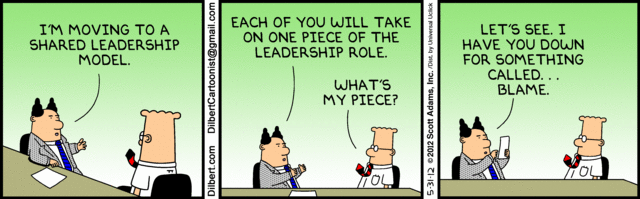
Lesson Six: Everything is about development, not blame
Common purpose should always overcome individual egos. If it doesn't, the result when interrogating certain data or findings is that people get defensive and therefore will not give the whole truth if they can avoid it. An openly debating culture within SLT such as I have witnessed at my present school allows all the facts to be put on the table without embarrassment so that everyone can look at what can be getting better. Just because you've been put in charge of an area doesn't mean you're bound to have all the ideas, and sharing your results, your doubts, your qualms etc allows others to contribute, allows you to get multiple perspectives, and ultimately allows you to come up with better collaborative solutions. But if your team doesn't have that open culture and common sense of purpose, you have to build it first.

Lesson Seven:
This one's for the SLT rookies out there. When someone asks you if you would like to take the minutes, the answer is no. Or a more polite version thereof. And if at the end they congratulate you and say that you have got "your turn" out of the way, what they mean is that the busiest agenda of the term is now over. Mwa-haha-haha-haha...

Next they'll be saying it's my turn to pay for the SLT team-building curry outing...

Saturday, 19 January 2013

Taxonomy of an iPad lesson

I haven't blogged about our iPad journey for a while, so I thought I'd update how it's going, and impart a few of the lessons I've learnt the hard way! Forgive the length of the post, but I thought it was time to get into the nitty-gritty of the learning which occurs when iPads are used so you can follow my thinking, and improve on what I'm doing (and hopefully suggest those improvements to me in a comment at the bottom? Who knows?). And I'll chuck in some cartoons to alleviate the boredom too, how about that?

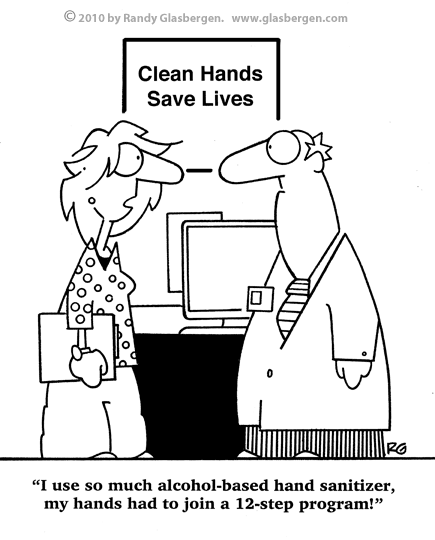
The first thing to comment on is a class procedure which has changed: The first thing my students do when they come into the class is to wash their hands with the anti-bacterial gel soap, a dispenser of which is on the wall at the entrance to the class. Bizarre, eh? One of the things which has always troubled me in schools is that, in a computer-heavy subject area like mine, cleaners NEVER touch the computers, keyboards or mice. And with the iPads' arriving, they certainly wouldn't touch those! (There is always the excuse that they're "not allowed to", but I can't honestly see it being likely that the person in charge of cleaning services is telling their staff any such thing). And kids, let's face it, are snotty and prone to poor hand hygiene. Some of you may be laughing at how remarkably understated I'm being on this matter... Anyway, I reckon that if you combine their hygiene habits (or lack of them) with the sharing of computers and iPads between 5 different classes every day, chances are you'd be able to account for a good 30% of the bacterial transmission within schools! And seeing as Dave Brailsford reckoned there were marginal gains to be had in keeping his cyclists healthy by using simple hygiene methods such as that outlined above, well, I decided to go for it. And I know this is anecdotal, but frankly the levels of attendance in my classes this year have been especially good amongst the classes using the iPads. Go figure. So, change number one: Hand gel at the start of every class.

Change number two: Organisation. We were very fortunate last term that SLT agreed to increase the number of iPads in the department to a full class set, with a charge/sync case. This has made the organisation and distribution at the start of classes a whole lot easier. All iPads were previously numbered, and allocated to individual students in each class, but what was numbered was the screens, so we still had a faff and a half opening them all and giving them out. Now, the sync case has numbered slots. Students know which iPad is theirs immediately, and where to put it back to charge at the end. 30 second procedure, including getting the ipads on. So far we are less than a minute into the lesson and students are ready to start. As opposed to the old Windows machines on the network which necessitated at least 10 minutes of "Bell work" before they were up and running and logged on. (The inverted commas around "Bell work" are there so you will recognise what I'm talking about, because I've re-christened it "Waiting for my f***ing computer to load, connect to the network and log me into all the correct drives work"). So, iPads definitely winning in the organisational stakes.

Change number three: Flipped learning: I'd always been a fan of flipped learning, the idea of setting learning for homework, and its application as a class activity which could be easily differentiated on the basis of how well the homework had been understood. The iPads have made this incredibly easy. The learning is set, and as soon as the students come in, the Socrative room number is on the board. The students now know to simply go to the Socrative app, enter the room number, and their quiz for the day will come up. If you haven't seen Socrative before, it is a web-based app which can be used on any device which can connect to the internet. Frankly, it's one of the most useful AfL tools I've come across. Look, I've even done a video tutorial for you here, and to the right, so now you have no excuse.

A few seconds after they've finished, I get email results telling me who has done well and who needs a bit more help (and who didn't do the homework at all!), and I can set them differentiated tasks or personal interventions to help them progress from whatever stage they are at. For example, yesterday we were analysing the front pages of magazines to see if we could work out what persuasive devices were used on audiences, and thereby identifying target audience characteristics. The class responses on Socrative clearly indicated that the class feel into four groups: The first set of responses clearly hadn't done the homework, so their first task was to do it to catch up (they re-take the quiz to prove it). The second group had not grasped a lot of the technical terminology in the homework, but understood the basics, and therefore they were given a cue sheet with definitions via dropbox to look at, to refer to during the analysis task. The third group did fine with definitions of key terms, but had struggled with the more open questions I'd set to test their application of the terms in analysis: They were also given a cue sheet of definitions (in case that was a problem but they'd guessed the vocabulary correctly in the test), but these definitions were a little more complex and used more media terminology, and also asked some key questions related to text analysis. I put these students in a group together to see if they could answer the more complex questions, and would then intervene more personally to answer their questions if they weren't sure. The final group had clearly understood their homework. They were given a set of additional questions to extend their thinking about the magazine techniques and get them to relate these explicitly to the target audience, and the sorts of gratifications they might get out of the magazine.

Although each group has been set off on different tasks because of their different starting points, this makes it easier for me to give them more individual attention without stopping the whole class, but essentially they are still working towards the same analytical task, just at the pace which is appropriate to their level of understanding. For the task itself, every group was then sent four documents: The mark criteria we had annotated into student-friendly language the lesson before, one model answer we had ripped apart the lesson before with the "What Went Wells' and "Even Better Ifs" we had written next to it, and another model answer we had looked at which was a WAGOLL. The final attachement was an Explain Everything project pre-populated with the keywords they would need for analysis. When they got to the analysis task, students had to find a hi-res google image of a magazine cover of their choice, and import it into the Explain Everything Project. They then re-arranged the key words with arrows to point to the features they could see, explained the connotations of each techniques and its effect on the reader, and finally wrote a summary on a second slide explaining why these techniques might attract the audience the magazine was targeting (below).


About half-way through the lesson, I stopped the students who were on the analysis activity, and put them into random pairs using the app RandomMastr, an easy to use list randomiser which the students are used to: They can see the results on the board through the AppleTV, so they know I'm not fiddling the pairs. The students swap iPads, and then leave feedback for their partner: Two WWWs and two EBIs. They had the mark criteria to refer to, and were told that their EBIs must be improvements which would make the most impact on the other student's result. If they wish (and several of them often do), they were allowed to use the mark criteria to guess what grade the piece might currently be on. The students often take advantage of this as they know I won't issue grades until the piece is finished. Another great feature of Explain Everything which some of them use is the voice-over recording: Some aren't great at expressing their improvements in writing, and so for the feedback I allow them to record their points verbally for their partner to listen to later. Once feedback is given, the students returned the iPads to their owners, and got on with improving their own analyses. And apart from directing the traffic, it sometimes seems as if I don't do much "teaching" in the traditional, stand-at-the-front-and-educate-them fashion. I just intervene on an individual level, and students seem to think this is far more effective, personalised, and suited to their individual pace of learning.


At the end of the lesson, I take a quick pulse check using Socrative again. We sometimes spend a bit of time talking about individual weaknesses or areas for further research, and that will form the basis of the students' homework, but the Socrative pulse check allows me to work out what areas they should be focusing on, based on a single hinge question. Students also have the opportunity to ask me a question through Socrative, which I can answer if the hinge question hasn't quite made it clear to me what a particular student's area of difficulty is. The students are set up for homework, have set their own tasks, and hopefully know what they have to learn ready for next time. They will then export their project to Evernote or to email so they can see what they have completed so far, to remind them while doing their homework, and that's pretty much all there is to the lesson.

This is the sort of lesson which can be endlessly fiddled with, modified, and combined with other techniques. For instance, we have started using SOLO Taxonomy as part of the peer feedback mechanism with one class, who are getting into it slowly. Similarly there are different ways of giving formative feedback to each other, including some of @Headguruteacher's brilliant "Closing The Gap" strategies. The one thing I hope you'll notice is that I haven't really mentioned the iPad that much throughout the post, and that's as it should be as far as I'm concerned. The whole debate shouldn't be about the technology (which is why I won't be drawn on the iPad/Android/BYOD debate): The technology merely facilitates the learning, and for that, you use whatever works best. I have a couple of students who really struggle with Explain Everything, so they are allowed to do their analysis work on Evernote. I don't have a problem with that. It's just a tool after all...

Saturday, 12 January 2013

Leadership and wisdom: Why us and them?

I'm in serious mood today. None of the usual frivolities. OK, you might get a cartoon at the end, but until then, I'm talking business...

I don't know about you, but I often have decent ideas which I'm developing at some bizarrely insane time of the day, when suddenly I will read someone else's blog which just, mortifyingly, turns out to be the perfect expression of what I've been struggling to articulate for so long. Today was such a day, when I read Kev Bartle's blog on line management, and the need to build a relationship of trust between manager and line managee (he made that word up by the way, not me). This line caught my eye: "And I trust that they (the people he line manages) are in this job for all the right reasons, as I hope they trust that I am in the job of senior leadership for all the right reasons." An admirable attitude.

However, this line highlighted a problem I have perceived, which has puzzled me throughout my career as a teacher and middle leader: The divide between SLT and "staff". If we just flip his statement on its head a moment, we perhaps start to see what is at the root of many a disjointed relationship between SLT and staff. Everyone always assumes teachers are in the job for the right reasons, but very often line management relationships break down because those being managed don't quite trust that SLT are in their jobs for the right reasons. Sound harsh? Think about it: How often are people sniping behind the backs of SLT members in your school? Is it only when the senior leader in question is not up to the job? Or is there a natural tendency amongst teachers not to trust SLT?

This isn't a problem middle managers suffer from as much, I don't think. While staff within a department can resent being managed by particular subject leaders on a personal basis, in my experience this is rare, and often down to a clash of personalities or perhaps rival ambition. Essentially, becoming a subject leader is about having ideas of how to teach better within a subject, and wanting to create a system through which this can be organised more effectively day to day. The fact that Subject Leaders still teach a hefty timetable shows the people they are managing that they are still 100% committed to the day to day nitty-gritty of the chalkface. But move towards SLT and suddenly things might change. Teachers seem to have a natural suspicion of people who are promoted to leadership positions, and it might be because they can't fathom why anyone would want to leave the classroom, which was after all the reason they came into the profession. The only reasons people seem to come up with are reasons such as greed (more money) or wanting to get out of the classroom (less work). Neither is a particularly positive reason for wanting that promotion.

One thing you'll pick up from the last paragraph is that I'm already using "they" to refer to staff, which posits a "we" of senior management (and I'm not even senior management yet!). I don't like that at all. However, it does seem to reflect the way staff think SLT view them, and it's a very real obstacle that must be faced, acknowledged and overcome by SLT if they are to be successful. I work with some superb colleagues in my faculty whose trust I have fought hard to gain over several years, and whose interests I have very often put way before my own, even when my own were important to me. But I am aware, and I don't think it's paranoid imagination, that having been seconded to SLT recently, there is now that degree of suspicion towards me and my motives. 

As SLT members it's vital to communicate our mission clearly to teachers, to make them see that our role is as much about people as teaching is. We may be part of a "system", we may have a grand title such as being in charge of "Teaching and Learning","Community" or however your school chooses the nomenclature of SLT, but those roles are still fundamentally about people. They should be about getting the best experiences for every single student, and should be equally about getting the best professional experiences for every single teacher and associate member of the support staff. They deserve to be happy and fulfilled in their lives and roles, as much as the students deserve the best educational experience possible. Our role in this context is about serving the needs of these two communities, and everything we do, say and set up should be transparently and obviously about facilitating that, and releasing people to fly. As @KevBartle said in his fab blog"I saw the angel in the marble and carved until I set him free". Although I think he may have nicked the expression from someone else: Attribution is one of Twitter's main problems!

How you convince the people you manage of this is a matter of personality, I think. There are no hard and fast rules. Our ASLDP course, for instance, discussed whether Heads should go to the staff party a while back, with clearly this question on their minds. Some said they should, and they should be seen to be able to "get down with the staff" as I believe they say on da streets, innit. They should even be willing to get drunk in front of their staff, some said: Shows they don't take themselves too seriously. It's a bonding experience. Others said quite vehemently that they should remove themselves and allow staff to get on with the fun without feeling they were being watched. I could see both sides (typical Gemini, apparently, whatever that means!). I don't see any good reason for Heads not to be involved in staff do's, but not because they feel they have to play a role. That is the most phoney thing we can do, because people see straight through it. You have to do what comes naturally to you, and lead in a way which aligns itself with your character. For me, that would include attending staff quizzes, nights out etc, but the line would be drawn at drinking (not something I wear well), singing and dancing in public, which have always embarrassed me, way before I was even a teacher. I'm not going to be able to change those things just because I suddenly have to lead people or want them to see me bonding with them. But ultimately I do need to convince them that I ought to be treated as a person, rather than a manager, and the best way to do that is to do likewise back.

Finally, I would like to draw your attention to another interesting argument I heard on TED a while back, and one which supports the assertion that we should foreground people over systems when leading schools: The idea is that whatever we do, we mustn't make systems or procedures the whole answer, because the unintended consequence is to take away our wisdom to decide human issues on a case by case basis, and the virtue and morality to treat people like humans. This might seem like a bit of a non sequitur in the context of what I've been talking about, but it says more or less what I've always thought about how we lead people: We deal with them as individuals, we highlight their strengths, we look to help them fly if they need help, and we get rid of any obstacles if they don't. And rather than trying to "catch them out" (credit to @SimonWarburton for this expression), we work on their weaknesses in the same context as they would, knowing that they will want to deal with those weaknesses as much for themselves as for anyone else. They don't need us on their backs in addition to dealing with them, they need us on their side. That level of trust and integrity is important to have between you and the people you work with. And it might just make them less inclined to think of you as "them": Credit to Pink Floyd for that line...


Saturday, 22 December 2012

2012 - What a year!

2012 was the Chinese Year of the Dragon. By reputation it is a stormy year, literally and metaphorically, with change as its only constant characteristic. Think of 1916, 1940, 1976 and 2000 and you get the idea. For those who can ride the storm, it's an exciting ride full of opportunities. and such has been the case for me this year.

Specifically it has been one of the most inspiring years I can remember for a long time. It's been the year of Twitter discovery, the year of turning the iPad pedagogy dream into reality, my first year of Outstanding teaching (apparently), and the first year I've begun to accept I may have something to offer at a level higher than middle management. The encouragement and inspiration I've received this year have been overwhelming (a lot of it from Twitter), and have pushed me along at a rate somewhere between uncomfortably hard sprint and mach 2 with lips gibbering comically. So I thought I'd finish my first month of blogging with a reflective one, looking at the things which have inspired me most this year, and hoping they inspire you too...


1) Teachers were heroes, and presidents were real people (whether this a real person with courage still remains to be seen, but I imagine 90% of the world's population will be willing him on in the New Year).


Felix Baumgartner - The mightiest of leaps
2) Science equated to discovery and inspiration: 
Higgs Boson, the Mars Rover, Felix Baumgartner's colossal jump from the edge of space - A year when Science re-discovered its cutting edge and inspirational qualities, but a year in which the real science (of saving our species' place in this planet's history) was once again subsumed by the interests of those with profit as their main motive.

3) Teachers innovated: Teachmeets and Tweachers came of age, and teachers reacted to an ever-growing chorus of criticism from government and the media with professionalism, integrity, and continued strife towards improvement. But these testing times, when politics and ideology rule over education, are also beginning to sift teachers and leaders into two groups: Those who acquiesce to the demands and play the game, and those who have the moral courage to stand up for what's best for their students. The latter group is in the ascendency I think.

4) The little people stood up for their future: Pussy Riot in Russia, democracy protesters in Syria, Libya and Egypt - A year when the little people stood up to be counted, and gave their lives for a better future. And the web played a pivotal role in that process, allowing people to communicate freely with each other across social and geographical barriers: On a lesser scale, we saw the growth of crowd-funded Kickstarter projects, and in the teaching profession we saw the formation of HeadsRoundtable and its massive online petitions, consultations and deluging the DfE with over 5000 tweets in one hour to protest against the EBacc "consultation" (if such it can be called). There's your moral conviction...

5) Gay Marriage Bill: Even though the church continues to object to gay marriage, this was the year that the rest of us saw it as a complete non-issue. For Heaven's sake, if the Conservative Party are advocating a more liberal stance than the church, what is the world coming to?! I just loved the picture opposite, which showed a grown man as though ashamed of his own message, and a young lad with courage and love in his heart. Who says the next generation is going downhill?

(Do love this video response from the gay community on what might happen if we don't let them marry each other: Hilarious!)

6) The Olympic legacy
I'll admit to being a nay-sayer when it came to the Olympics, and then it changed my mind, for so many reasons. The inspirational performances were just one aspect of the whole thing to be honest. I loved the fact that we saw immigrants as accepted parts of our society who wanted to help make this a great country rather than simply a racially homogenous one; I loved the way we came to see 
Paralympians and disabled people as heroes rather than as scroungers, benefits cheats, or a drain on the nation; And most of all (as a media specialist), I loved the fact that the people we idolized were for once not over-paid ponces (footballers, looking at you here!) or people with little talent who'd made it through "reality TV" and been told they were the next big thing. The Olympians were people who excelled at their sports, achieved their success through incredible hard work over a long period of time, and when they'd finally achieved it, had the humility to admit that they were only part of a team, and that their achievements were only a blip on a much larger scale. People who are often aware of their own lack of importance in the grand scheme of things are often the ones who achieve and give most in life. That's a true legacy.


Finally, I had to leave this year's review with two of my favourite videos of the year: You're going to tell me they're the same: Same tune, same theme, same Olympic footage. But there is a subtle difference. While the first is a celebration of the Olympics and its trials, tribulations and successes, the second I think is more powerful.

Because it's about more than the sportsmen and the sportswomen who did us so proud. It's about us as well, and our role as ordinary people. It's about everybody who made it happen, made a difference, and made it such a special time for Britain (not just London). It's about ordinary people clubbing together to show how great a nation's people are, without jingoism or feeling any need to be better than anyone else...

If we're going to do anything to leave a legacy in 2013 (and seeing as yesterday went off without a hitch, and Mayans are still investing in pension funds, we can assume we do still have a future on this planet!), it should be to realise our potential as a species within the great ecosystem which is our planet.

It should be about looking out for each other.

It should be about looking out for our resources, and sharing them equitably.

It should be about realising with humility that our survival depends on working in harmony with this beautiful planet, and not simply in our own selfish interests.

A final quote, to leave you with this year. It's from a book I read years ago that is unique in its ability to constantly remind me of how tiny my place in the world is. As my Christmas gift to you all, may I recommend "Tuesdays With Morrie", and may we all continue to strive to make this a better place to live next year... Merry Christmas!


You’re not a wave, you’re part of the ocean.

“I heard a nice little story the other day,” Morrie says. He closes his eyes for a moment and I wait.
“Okay. The story is about a little wave, bobbing along in the ocean, having a grand old time. He’s enjoying the wind and the fresh air–until he notices the other waves in front of him, crashing against the shore.
“My God, this is terrible,” the wave says. ‘Look what’s going to happen to me!’
“Then along comes another wave. It sees the first wave, looking grim, and it says to him, ‘Why do you look so sad?’
“The first wave says, ‘You don’t understand! We’re all going to crash! All of us waves are going to be nothing! Isn’t it terrible?’
“The second wave says, ‘No, you don’t understand. You’re not a wave, you’re part of the ocean.’”
I smile. Morrie closes his eyes again.
“Part of the ocean,” he says, “part of the ocean.” I watch him breathe, in and out, in and out.
Extract from the book Tuesdays with Morrie 
By Mitch Albom
All rights reserved.
New York : Doubleday, c1997.