Showing posts with label management. Show all posts

Saturday, 10 October 2015

Well-being

I've read a lot of really good blogs recently about teacher well-being, and what a tough nut it is to crack. Depending on whether you come from a leadership point of view or a chalk-face view, you will have different interpretations of where the problems lie, and what the solutions might be.
@kevbartle talked recently about the tokenism of some approaches (free tea and coffee anyone?), or the tick-box approach we are often forced to adopt by external agencies who also want to be seen to be "doing something" to solve the problem. Surprisingly, none of them seem to work. Surprisingly.

For what it's worth, here is my contribution to the debate. I hope it gets to the nub of the problem:

The first given in the debate is this: The business of schools is to produce students who, be it through good exam results or just more ambition, self-respect and belief, are ready for the outside world. We are there to give them "life chances" in the jargon. In a utilitarian view of education, they are the product which feeds the economy, and the product has to be top-notch. From a more humanitarian perspective, students are individual humans whose contribution can improve society if we have done our job well.

The second given is that our job as teachers and school leaders is to deliver that. The ultimate needs of the students must come above our own. Unfortunately, this very often includes the needs of staff well-being, or the needs we may have as normal human beings to have a life. We have chosen a career which, if we let it, can degenerate into a massive black hole for all our energies.

In this context, my contention is this: If students are the products of the system, we are the craftspeople who shape the product. We, and I realise I am risking derision for my choice of words here, are tools. If you're happy for me to carry on with this analogy, it works like this: A craftsman chooses how well he keeps his tools. He can buy them cheap, use them until they wear out, and then just get rid of them. Or, as is the case with real craftsmen, you can look after them carefully, keep them sharp, and produce excellent work with them for a long time.

For me, the well-being debate boils down to this: As a school leader, do your actions contribute towards wearing the tools out prematurely or do they contribute towards keeping them as sharp as possible for as long as possible?

To make my point, under which of the two categories would you place the following activities?
  • Free tea and coffee at break-times
  • Creating support systems around the school (ICT, SIMS, First Aid, school comms etc) which just work reliably day in day out
  • A reliable and easy-to-use VLE
  • Time to meet in teams to plan lessons together
  • Audits of lessons, learning objectives, marking etc
  • Staff socials
  • Timetables which minimise split classes, room changes, etc
  • Timetables which give staff time to socialise and discuss daily problems
  • Setting up a staff well-being committee
  • Staff freebies, such as health insurance or discounts on well-being services
  • Thinking hard about any new initiative, and whether it adds to or distracts from the "main thing": Teaching and learning.
To me, anything which allows teachers to teach more effectively and more efficiently is a sharpening tool: Anything which gets in the way of that is blunting the effectiveness of the tool. Ultimately, that will have knock-on effects for the outcomes we produce as schools.


Sunday, 4 August 2013

Leadership secondment: a great experience

Those of you who have been following my blog over the last few months will know/have surmised/been told/have no idea whatsoever that I was seconded to our leadership team for the past two terms. I can honestly say it probably came at the worst possible time for me, with a colleague who had just left the department and not been replaced, having to take on their exam classes, dealing with some serious personal issues of a couple of colleagues and trying to be a decent father and husband (the last two have been more or less accepted as optional by my family for all but the month of August each year, but that doesn't mean I stop trying, or at the very least feeling guilty about failing!). By the end of the process, however, I would say that it was one of the most worthwhile professional things I have done in the last few years.

The reasons for this might be divided into two: The worth lies in what I achieved (which is open to debate) and what I experienced. The latter I think is the most important, especially given the paucity of my achievements. I'm sticking with it as the most important thing at any rate. So what did I experience?

1. The opportunity to organise a whole-school project

Anyone who has read the non-leadership-y blogs of mine will know that the other element I've been captivated by this year is the potential for mobile technology to transform learning. Because of what I'd been doing in the classroom, other colleagues and leadership were getting interested in what I was doing (or wanting to know how I could justify all the expensive iPads at least). Having discussed the potential of the iPads, and the way they were transforming the teaching and learning in my classroom, it was clear that this was a way forward which could really benefit the school, but as I've written elsewhere, we were in no financial position to afford a 1:1 iPad programme. The compromise, which actually turned out to be far less of a compromise than I would have thought, was BYOD.

The scope of the project itself was huge: It consisted of getting SLT and teachers on board, getting technicians on board and working out how to get the network ready, getting student involvement, getting Digital Leaders trained, and trying to manoeuvre a lot of different elements into place simultaneously which gave me a sense of playing twelve-dimensional tetris permanently for seven months. It's arguable that there is no better training for Assistant Headship than exactly this! The whole project is now an integral part of our next three year focus in school, on the personalisation of learning, so I will genuinely be able to say that I have had an impact on teaching and learning across the school which, by the time the project is fully rolled out, will have affected every single student's learning. When you're a middle leader trying to take that next step up the career ladder, this is often the missing link, the whole-school dimension, where candidates come up short.

2. The opportunity to lead CPD

I have rarely worked in a school where there has been such a relentless focus on high-quality CPD, and where the majority of it has been provided by our in-house experts. The BYOD project gave me the chance to lead some of the individualised training our school runs for its staff in order to develop them all as far as we can, and also offered me a chance to view the principles and logistics behind that training programme. For my part, I was able to deliver CPD on how teachers can make use of mobile technology in their teaching and learning, to provide high quality assessment for learning opportunities, and to give students a huge amount of choice in how they learn, and how they present their learning. The CPD I delivered also gave my CPD co-ordinator a good idea of how advanced these practices were, and she in turn gave me the opportunity to deliver similar training to other teachers at TeachMeet Brum (1 and 2) and TeachMeet Cov, as well as at the Coventry Teaching and Learning Partnership. These consequently provided me with networking opportunities with other far-sighted teachers, middle and senior leaders and exposed me more importantly to doubts and questions about what I was introducing which were both sincere and legitimate. By the time I'd gone home to reflect on those questions and obstacles, the planned whole-school initiative was beginning to become much more water-tight, and much less likely to fail. That kind of high-level scrutiny and collaboration has been really useful in formulating my ideas, and also in giving me the confidence that the ideas themselves are worth carrying out from the point of view of enhancing teaching and learning, rather than being just another "initiative". My best moment was when a friend who is high up in the IT industry told me (after a half hour grilling me about our BYOD plans) that he couldn't find a flaw or a gap in them. High praise indeed. For the first time in my career I don't feel as defensive, and I don't see criticism as a negative, but as an opportunity for reflection and growth. Again, a real benefit to my career, no matter which direction it heads in from now.

3. The opportunity to observe a high performing leadership team

The chance to see how a high performing team operates, and what characterises them, was another key learning development for me this year. I got the opportunity to see how this team was shaped by strategic thinking and planning, long-term plans, conviction that your plan will do the job and get the best results, constant checking of the data, digging for the detail and the stories behind it, a focus on excellence rather than initiatives, a daily togetherness and opportunity to talk about operational matters, weekly meetings which were purposeful, focused and always about how to get the best for our students.
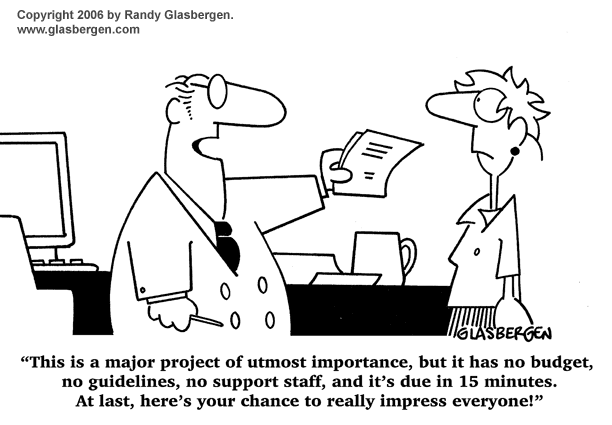
Copyright owner: Randy Glasbergen
I got to see that, while middle leaders and below often think of SLT as purely results-focused managers, they were actually focused now not just on the results, but also on the adults they wanted our students to become: There was review of the curriculum experiences of the students, their extra-curricular experiences, and the out-of-school opportunities we offer them. We spent time looking at different curriculum models such as the IB, the Middle Years Programme etc, and thinking about how closely the experiences they offered matched our aspirations for our children. Oddly enough, the current turmoil within our educational system served me well, as I got to see a team focus on the basics of the educational experience, and prioritise the things which really matter. I came to see that outstanding curriculum, teaching and learning, student experiences etc are never the result of accident or chance.

3. The opportunity to contribute

Within this context, I also had the chance to contribute to the above debates and see whether or not my own ideas stand up to scrutiny at such a high level. I think that's probably all I need to say on that section. They weren't laugh at. To my face, anyway. From my point of view, big win.

4. The opportunity to see how high-performing teams are forged

One of the most significant aspects of the secondment for me was seeing how high-performing teams are built and exploited to get the best out of each person. Like any good classroom, the team were divided differently for different tasks and projects, sometimes clearly in light of what they could bring to the project from their own expertise, but at other times to develop more latent skills which each member of the team perhaps needed to work on to become a more effective and rounded leader. There was a constant theme of support, and wanting to maximise the talents within the team, but also a feeling that they were constantly being asked to move forward, and become even better, even more balanced as individuals. What did I learn about myself within this environment? Well, apparently I've got some decent ideas. I have a focus on systems and strategy which will serve me well, but I also have a good eye on people, and hopefully won't ever put the systems above those people delivering them. Within a high performing leadership team, I held my own, hopefully, and would consider I had a shot at most AHT jobs. Having said that, you can probably see through the number of grammatical qualifiers and self-deprecations in the last few paragraphs that I haven't quite shaken off the demons of my own self-doubt. What I did get to see was that this isn't an entirely negative flaw, and that it also makes me a reflective person, which will again serve me well for the future as I try to grow professionally.

One interesting exercise we undertook as a whole team was a ColourWorks exercise, run by a company (ColourWorks, surprisingly) which asked us to answer a series of random and somewhat irritating questions and then presented us with a bunch of results about our leadership style. Considering how meaningless the exercise felt at the time I was doing it, I have to say that the results were stunningly accurate and insightful. I have  20+ page document at home about me and my leadership style from which neither I, nor any of my family, colleagues or friends have been able to fault more than about three statements. Interestingly, I am less gregarious in leadership than I like to think, and more reflective and logical. I am not pushy, or fiercely driven, and I always value consensus and people. As a result, I think I might be cut out for leadership up to certain levels, but not Headship. I am a good team player, and I can always help others improve their own ideas further, but I'm not necessarily a top leader. Perhaps it's a question of happiness or personal priorities: I find myself not driven enough by ambition to want to disrupt a work life balance which brings me great happiness and satisfaction as well as challenge. I'm not looking to be in a rut, I'm not wanting to coast: I genuinely want to be the best teacher and leader I can be, and to make a difference to as many students as possible. But I think at the very top you need a certain amount more self-belief and, let's face it, cojones, to take on those challenges and assume responsibility for everyone under you. One thing that does occur to me, however, is that someone like me, who doesn't allow things to get in the way of my own happiness, also understands how important this happiness and sense of personal satisfaction are for staff well-being as a whole, and that is an excellent attribute to have on any leadership team.

5. The opportunity to see where middle leaders fit in

As a middle leader I understand my function within the school much better now, and what opportunities I have to be able to help the leadership team by speaking up on matters whose impact I am better placed to understand than they perhaps are. This has also given me far more confidence to express those views, and I've noticed the same confidence emerging in others who have also had the same chance to undertake a secondment as I have. My bond with these people has now become much stronger as a result, and I can see that one of the points of offering secondments to middle leaders is to build this capacity for growth, self-discovery, development, and confidence. Similarly, from the leadership team's point of view, seconding middle leaders allows LT to gauge how broad or parochial the views of school issues are to those middle leaders, as well as how practical, feasible and strategic they are, so that when these middle leaders are consulted on matters affecting the whole school, the leadership have a good deal more faith in the feedback they get if they know the middle leaders in question can see things from both sides of the fence.


So in conclusion... 
  • I enjoyed the experience thoroughly
  • I enjoyed the challenges, and really enjoyed the whole-school responsibilities
  • I learnt an immense amount about how schools function, about how leadership works, and about myself and my own style of leadership
  • I learnt that leadership teams have real people in them too! And I learnt how to curb my natural tendency to bow in deference to superiors
  • I would recommend this to anyone, even if it's just to see what lies on "the other side of the fence"
  • If I hadn't been doing this on my full time-table, I think I would conclude that I might be able to manage a leadership job!
And finally, I would say I have learnt this, which I would like to pass on to all potential leaders, of the present or of the future:

Leadership without clearly defined core values, and aims which are consistent with these values, is nothing. Leadership without integrity is nothing. Leadership without reflection and questioning is nothing. Leadership without clear, consistent, transparent communication is nothing. 
There's a reason we are given twice as many ears as mouths, but once you're done using the ears, make sure that what you say is true, committed and strong.

Oh, and if any of you are thinking I could easily have describe Michael Gove here, go back and re-read the ears thing.

Now, who's going to give that job...?


Saturday, 16 March 2013

Making Learning Irresistible


Mick Waters
Making learning Irresistible

Last  weekend was my first experience of the Coventry Learning Partnership Plus conference, and unfortunately I didn't really get the full flavour of all the excellent workshops going on because my school volunteered me to run one! What I did have was the privilege of hearing Professor Mick Waters talk to us on the Friday night about making learning irresistible. He talked for 90 minutes. It barely felt like 10.

I talked to several people afterwards about what they'd taken from the speech. We were all inspired, but could we put our finger on what exactly the thrust of the talk had been? Could we hell! This blog is my attempt to try and draw some conclusions from what I heard, and summarise where Professor Waters thinks we should be heading in education, a direction I have to say from the outset that I whole-heartedly agree with.

By way of personal context, there has been a lot of talk in our leadership team at school about the role of character in a child's education, about teaching more than simply content, "subjects", and even learning skills. Our current education system seems intent on reducing the really important things we teach our children to lip-service, as it is perhaps not deemed to be measurable, valuable or, dare I use the jargon du jour, "rigorous". This isn't a party political point, as I think the last government's focus on targets, attainment etc are equally blame-worthy in this respect. And nor am I saying we shouldn't be accountable for our results. I am simply arguing that our present focus on what can be measured has created an unhealthy obsession with those things over the other important areas of our educational remit, namely to help students to discover who they are, what they can do, to foster their curiosity, to nurture their talents and interests, and to get them to understand how to accomplish their goals meaningfully in a way which is as beneficial to society as it is to them. Children who care, rather than children who spend, perhaps. Though I'm told this is bad for the economy. By which of course we mean the rich folk at the top of it. Moving on...

Professor Waters' starter for the ten is the contention that, in order to prepare for and learn about the outside world, the UK for some reason corrals students behind a fence, in institutions where we actually ignore and fall behind the real world all the time. We are obsessed by the need to get on, get through the content, and miss out on the chance to make things come alive. In our efforts to have our students undertake "meaningful" activities all the time, while taking the register for example (we make them do planner checks, numeracy activities, give them tonnes of information etc), we fail to realise that the real world is always there to be tapped into.

Our focus on results has another very negative effect on students: We label them. And we label them in a way which stigmatises them deeply, despite the fact that what we are labelling is transient. One child can't do equations yet. Another has difficulties focusing at a certain time of day. Another can't get to grips with a couple of particular subjects, so we label them "Not achieving 5 A*-C grades"! Here's the thing though: If you were to grade yourself in different subjects at different times, how would you fair? On a scale of Outstanding to Unsatisfactory, how would you rate your own abilities in relation to gardening, decorating, writing, taking photographs, playing an instrument or learning a language? I imagine few of us would be excellent all-rounders, but that's not to say we don't have serious talents in one or more areas: Just look at Einstein. Bit of a failure in school by all accounts. Likewise, students are at different levels in different subjects at different times, but our need to measure things makes it easy for us to focus on the numbers and not the child in front of us. Do the numbers really tell the story? Oddly enough I was listening to a Radio Four business programme the other day where several chief execs were agreeing on this very point, and saying that the data they got on their desks every day was a deeply inferior diagnostic tool compared to direct contact with their people on the ground floor and their customers. A lesson for us all perhaps...

So back to the students: Most of us start out positively in school, but even with the best of intentions, because we can't invest sufficient time to master a skill to the outcome level we want, we end up as "disillusioned triers" who give up on our ability to learn it. Waters does a great experiment with kids: He asks them how they would rate themselves in all of their school subjects. Apparently you never get more than 40% say they're any good at something. But if you ask them about how good they will be at driving and learning to drive, and whether they'll be any good as drivers, they respond overwhelmingly positively. About something they've never tried before. Is it the learning experience which puts us down, or the labeling which occurs along the way?

Similarly we could ask as professionals whether a teacher whose lesson is described as "satisfactory" is actually a satisfactory teacher? Or is this just a label? A snapshot. Under pressure too. Like a terminal exam even. Strikes me as a bit unfair to judge us this way on an annual basis, never mind judging a whole school every four years using that method. But boy do we bust a gut to get the "Outstanding" label! Professor Waters' conclusion was that the Outstanding teacher teaches good lessons consistently, but more than that: He or she also looks after the lonely child in the corridor. Is the latter any less important that the former? Are the teacher who have left a life-long impression on your lives the ones who taught tight formulaic "Outstanding" lessons every day? Or the ones who cared? Who took the time to listen to you? Who took a genuine interest in you as a person?

Many Outstanding schools are outstanding because they follow "the trudge", and they do it well, and have hit the right formula. The relentless focus on "5 A*-C grades", "RAISEOnline", CVA, the systematic monitoring, the countless interventions: All of these serve to get as many students as possible over that finish line which the data says they should cross, based on mathematical probabilities and algorithms we shouldn't question because they're far too complex for us to understand. And then they suspend the timetable for a day occasionally so that they can do a whole-school activity which will provide the rounding out of their characters (!) which society also requires. Are we really delivering that? Not according to Mick Waters', industry, the government, the parents or the Daily Mail!

A futures learning outlook

What we really need is to focus on what we hope for our students. The government is more focused on the core of knowledge, but we should be producing rounded human beings, and enthusiastic, curious learners. An outstanding teacher's role is to raise the spirits and self-esteem of their students, and to raise their gaze so that they look up at the world around them and see themselves as part of it. Our role is to help them find out who they are, and how they can make a positive difference to the world, and find a sense of their own happiness within the roles they choose for themselves. Our curriculum should be based on the big questions, with students clear about how the small matters fit into the bigger picture. It should prepare them to tackle big questions, and connect to the real world every lesson. Every child should be able to see the relevance of lessons for life in the big wide world as it is today. But I would suggest that this is just one aim. The second, and more important one as far as I am concerned, is this: If we start by showing students how their learning connects to the real world as it is, we should also be fostering the kind of curiosity and thinking which will help them shape the society that we could have. Because demonstrating to students how they could fit into modern society means we implicitly accept everything about that society, including its values and priorities. And I for one think that this demonstrates a real paucity of ambition. I would hope that our children can do a better job of society than we have. But it's unlikely to happen if we persist in telling them that what we have now is the only way it can be done.


The best summary of this perspective I've ever seen was written by a man named Kahlil Gibran, in a brilliant book full of wisdom call The Prophet. Given the daily vacillations in education policy and debate in this country, these thoughts help to anchor me as a teacher and a parent.

Your children are not your children. 
They are the sons and daughters of Life's longing for itself. 
They come through you but not from you, 
And though they are with you, yet they belong not to you. 
You may give them your love but not your thoughts. 
For they have their own thoughts. 
You may house their bodies but not their souls, 
For their souls dwell in the house of tomorrow, which you cannot visit, not even in your dreams. 
You may strive to be like them, but seek not to make them like you. 
For life goes not backward nor tarries with yesterday. 
You are the bows from which your children as living arrows are sent forth. 
The archer sees the mark upon the path of the infinite, 

And He bends you with His might that His arrows may go swift and far. 
Let your bending in the archer's hand be for gladness; 
For even as he loves the arrow that flies, so He loves also the bow that is stable. 

Saturday, 9 March 2013

Leadership - A different perspective


I remember a while back posting something (undoubtedly trivial - I can't remember what it was at any rate!) on Twitter which caused my first ever Twitter argument. It came as a bit of a shock because, while I know there must be good and bad on Twitter as anywhere else, my experience for the first few months had been entirely positive and incredibly helpful! PLN, best CPD in the world, all the clichés people use about Twitter had been true. And yet here was a full-blown argument, conducted in less than 140 characters. Its brevity made it no less ferocious. It was the ninja one-inch punch of rhetoric.

What was more stunning was the topic of the argument. My transgression had been to quote "The Art Of War", an ancient Chinese text by Sun Tzu, in an educational discussion. This was deemed "wholly inappropriate" amongst other things. I was told firmly that this had "no place in a discussion on pedagogy or education at all for that matter". Oh well. That's me told.

Two things I should make clear in response to this:

1) I think you can learn from anyone or any event. What a bad one looks like is as instructive as what a good one looks like. The amount you learn is dictated by your attitude as a learner.
2) I don't think this blog is being written to justify my position or opinion, in response to someone having a go at me. I'm not that insecure.

On the contrary, I'm writing this out of a genuine sense of wanting to explore what the ancient taoists can teach us now, about life, about teaching, and about leadership (my new hobby, apparently, as one of my team informed me today!). I've been interested in Oriental philosophies for a long time, so this will be the first of many posts (I'll get back to normal education-based posts soon enough, don't worry, and you'll still get cartoons at the end: Fret not.  But if @KevBartle can digress into poetry, then I can bloomin' well go East. So to speak. Anyway, here are my first findings...

What Taoist Philosophy can teach us about leadership

Sun Tzu, The Art of War, Chapter Three - Strategy

There are three ways in which a ruler can bring misfortune to his army:
If he orders the army to retreat or advance when it cannot effectively do so, this is called “hobbling the army”;
If he attempts to administer the army when he does not know how, its warriors will become frustrated;
If he commands the officers without proper insight into how they function, this will undermine their confidence.

Okay, so let's forget the military metaphors for a start, and focus on the essence of what's being said here, and how we can apply it to our work as leaders of schools. "If he orders the army to retreat or advance when it cannot effectively do so, this is called “hobbling the army”." Leaders have to have a strong sense of vision. Without it, it's difficult to know where you're going. And someone who doesn't know where they're going is either static or going round in circles ineffectually or, worse still, following every prevailing wind. But a leader with vision is only half the story. A leader with a vision has a plan. But he must also have the means to execute the plan, the tools for the job. A leader cannot do anything without the right tools, the tools to do the job effectively. That means getting the right team around you, the right mix of skills, the right structures and systems for effective action, the right staff, the right attitudes, the right environment and resources, the right attitudes from students, and a level of support from parents. Don't get me wrong: I'm certainly not saying that you replace people who disagree with you, but you certainly need to explain your plan, your rationale and your methods openly if you want to take them with you on the journey. You can't skip that step. Attempting to move a school wholesale in a given direction without laying the groundwork first just doesn't work.

"If he attempts to administer the army when he does not know how, its warriors will become frustrated."
There are a couple of things which strike me about this line. The first is the word "administers". As school leaders we might object to it, because it implies that we are more or less pen-pushers. Me, I like it. It's not saying that school leaders do nothing, but it's a useful reminder that impact in schools comes from the contact with the students, and that's down to the huge number of teachers and other staff we have at the coal-face. If we as leaders made most impact, surely we'd have more leaders than teachers. But that's not the case. The war is fought on the front-line by the soldiers, not the generals, and while it is entirely wrong to think of educating young people as a war, the metaphor still speaks to us about the relative importance of teachers and leaders.

The second thing the passage raises is the issue of competence: An incompetent leader will often put obstacles in the way of effective teaching and learning across a school. Sometimes teachers with integrity will try to point this out, but leaders can be less than receptive about criticism, and so sometimes these same teachers will simply circumvent these inadequate systems. As a result they'll be labelled as undermining the system. Fine line, isn't it? The onus is on us as leaders to be really reflective about how much more effective each of our systems is actually making the school.

In addition, that line raises a further issue, which is whether or not you as the leader need to be competent in all areas. I would argue not (if you've ever met me and are aware of my numerous flaws, you'll understand why I come down on this side!), but I do think you need to have people in your team who are good at the things you're not good at if that's the case. If you're a big picture person, make sure you have a details person in your team. And ultimately, all of this comes down to whether or not the leader is humble enough to recognise their own short-comings and either deal with them (good) or turn them to his advantage by helping others to advance themselves through their skills (excellent).


"If he commands the officers without proper insight into how they function, this will undermine their confidence."

You need to know your team, and their strengths and weaknesses, and you need to know their roles, the complexity of their roles, and what they do every day. One senior manager I used to know had a habit of responding to problems by saying that staff "just had to... (Insert small extra task here)". All very well, but you sometimes got the impression she'd forgotten everything else the staff were doing already, or how much had been added gradually through time to their roles and responsibilities without taking anything out of the mix. A good leader still appreciates where their staff are coming from, what they do daily, and thinks about how their own actions impact on the effectiveness of their staff. If they don't, the staff will often grow resentful, lose confidence, and lose their confidence in their leader. "Are my ideas making us more effective?" should be a mantra pinned to our desks, if not tattooed on our foreheads (though I can understand the argument that the kids find tattoos like that uncool and your kudos with them might go down the toilet!).

By the way, as I write this, it strikes me that I may be entering an egg-sucking granny style scenario, and I appreciate it's not rocket science. I think I'm just saying that we need to systematically step back from time to time to look at how what we do impacts on the students, their progress, their character development, and the staff and their work-life balance too.

OK, time to stop rambling. If this is useful, I've only really scratched the surface of one taoist tome so far: There is plenty more where that came from, but if it's not useful, please let me know and I'll stop cluttering your bandwidth with this rubbish.
(If it is useful, please let me know too: I'm not insecure, but a little approval is always a nice thing. Ahem...)


Saturday, 26 January 2013

What I'm learning on SLT secondment


I've been a Subject Leader since my second year in teaching. Virtually every time I've been appointed to lead a department, the appointment was to say the least fortuitous, if not utterly accidental. I have never felt the need for promotion, and have only ever gone for promotion consciously when I've got to a point of such frustration with the "I could do a better job than that" attitude that I've just gone for it. Never have I really believed I had much to offer at any level higher than middle management.

However, the school I work in at the moment have a habit of giving people opportunities to lead, and I've taken everything that's come my way in the last year. Again, none of this is out of any egotistical desire to be in charge, but much more out of curiosity, to see whether I actually have anything to contribute at SLT level: I'm not 100% convinced yet, but... Amongst the opportunities I've been given have been a place on the Aspiring Senior Leadership Development Programme, and a secondment for two terms onto our Leadership team. Over the next few months, I'm hoping to be able to blog about what I'm learning, and share it with anyone else who might, more fool them, be interested in what I have to say.

So let's start with this: Over the last few weeks it's been a privilege to observe first hand the remarkable group of people that is my SLT. I'm not saying this to suck up. None of them read this blog (I think). It would be embarrassing if they did. Not to mention a waste of their time. So this compliment is just between you and me, you understand?

I have always been impressed by the unity of the team since they came together three years ago. When I was seconded, one comment I received from a slightly cynical colleague in another school suggested that once I was on the team and could see what went on behind closed doors, "I'd soon see where the fault-lines were": But no...

Lesson One: Unity of purpose and vision
When you lead people, you have to have their confidence, and they have to believe you know where you're going, that you have a clear rationale for going in that direction, and that you know how to get there. Importantly, if you're in charge of a team leading another even larger team, then that SLT has to be behind your ideas, otherwise you get the sort of back-biting that undermines the team and the leadership completely. When the weavils start gnawing at the rudder, don't be surprised if your boat goes nowhere. Is a phrase you're not likely to hear again today...


So getting everyone on board is a very powerful tool in inspiring confidence.

Lesson Two: Keep it simple, stupid.
Uncontentious is a good way to get everyone behind your general principles. Teachers are all pretty well-intentioned people, or at least started out that way. They come to the profession with a desire to make a difference, and your leadership vision has to reconnect them to that original moral purpose they came with. They have to feel they are coming to work every day to do the thing they wanted right from the off: Change the lives of young people for the better. How you achieve that vision of success for young people can be debated ad infinitum within SLT, openly and honestly, but as long as you agree your general direction, then there is strength in your position as a group leading the school. The main thing is the main thing.

Lesson Three: Communicate the vision clearly and often
Alignment is a word much used on the ASLDP, and I must admit it is a word which is easily mistaken for coercion, which naturally gets people's backs up. But if you don't have a set of values and principles behind which people can align themselves, then why would they follow your direction? Learning to communicate your vision to the staff, and overcoming the suspicion people have of anyone who wants to go into a senior role, is a fundamental part of your job. Remember that most teachers came to teach young people, and therefore may well have a pretty legitimate suspicion of anyone who seems to want to "escape the chalkface". Your reason for being a member of SLT has to come through loud and clear in your words, but most importantly in your actions: It's about service. As a teacher, you can serve students. As a member of SLT you can serve students, and you can more importantly serve teachers in order to help them to do their job better. Repeat, in case you didn't get it first time: It's about service, and communicating your mission to serve others.


Lesson Four: Put in place the right systems
The word "system" conjures up a mechanistic view of management which most people hate, because they're people, and nobody likes to think of themselves in a box. But your systems are for two purposes: To make it easier for teachers and students to do their jobs, and to monitor and interrogate how that can be done even more effectively. Good systems of accountability should be light work, but provide excellent evidence upon which to act. If you are systematically asking the correct questions, the answers you come up with can automatically be looked at, and take into account individual variability such as student or teacher performance. But it's important that those questions be asked, that the story behind the figures be found, and that the knowledge that they bring is on the table for discussion.

Lesson Five: Create an effective team
A group is not a team. School "teams" are often inherited, and made up not of people who have ability and aptitude to lead the school or carry out specific tasks, but more often of people who have been teaching longer or have specific experience in schools. However, if this is the culture which exists in education today, we have to work with that, rather than bemoaning the fact that we can't just fire someone and hire the right specialist, as they might in industry. It's important to develop our leaders into a team, as they will model everything the school aspires to be: SLT should work towards becoming...

  • A team with shared purpose
  • A team which builds up complementary skill-sets and capacity (the right "chemistry", if you will)
  • A team which reviews the school's activities and processes (as well as its own) constantly for refinement
  • A team which learns from its mistakes and moves forward
  • A team which develops its emotional intelligence in order to make dealing with teachers and students more effective
  • A team which trusts its own members, the teachers it serves, and which is in turn trusted by staff and students to run the school in a direction which is mutually beneficial to all

Lesson Six: Everything is about development, not blame
Common purpose should always overcome individual egos. If it doesn't, the result when interrogating certain data or findings is that people get defensive and therefore will not give the whole truth if they can avoid it. An openly debating culture within SLT such as I have witnessed at my present school allows all the facts to be put on the table without embarrassment so that everyone can look at what can be getting better. Just because you've been put in charge of an area doesn't mean you're bound to have all the ideas, and sharing your results, your doubts, your qualms etc allows others to contribute, allows you to get multiple perspectives, and ultimately allows you to come up with better collaborative solutions. But if your team doesn't have that open culture and common sense of purpose, you have to build it first.

Lesson Seven:
This one's for the SLT rookies out there. When someone asks you if you would like to take the minutes, the answer is no. Or a more polite version thereof. And if at the end they congratulate you and say that you have got "your turn" out of the way, what they mean is that the busiest agenda of the term is now over. Mwa-haha-haha-haha...

Next they'll be saying it's my turn to pay for the SLT team-building curry outing...

Saturday, 12 January 2013

Leadership and wisdom: Why us and them?

I'm in serious mood today. None of the usual frivolities. OK, you might get a cartoon at the end, but until then, I'm talking business...

I don't know about you, but I often have decent ideas which I'm developing at some bizarrely insane time of the day, when suddenly I will read someone else's blog which just, mortifyingly, turns out to be the perfect expression of what I've been struggling to articulate for so long. Today was such a day, when I read Kev Bartle's blog on line management, and the need to build a relationship of trust between manager and line managee (he made that word up by the way, not me). This line caught my eye: "And I trust that they (the people he line manages) are in this job for all the right reasons, as I hope they trust that I am in the job of senior leadership for all the right reasons." An admirable attitude.

However, this line highlighted a problem I have perceived, which has puzzled me throughout my career as a teacher and middle leader: The divide between SLT and "staff". If we just flip his statement on its head a moment, we perhaps start to see what is at the root of many a disjointed relationship between SLT and staff. Everyone always assumes teachers are in the job for the right reasons, but very often line management relationships break down because those being managed don't quite trust that SLT are in their jobs for the right reasons. Sound harsh? Think about it: How often are people sniping behind the backs of SLT members in your school? Is it only when the senior leader in question is not up to the job? Or is there a natural tendency amongst teachers not to trust SLT?

This isn't a problem middle managers suffer from as much, I don't think. While staff within a department can resent being managed by particular subject leaders on a personal basis, in my experience this is rare, and often down to a clash of personalities or perhaps rival ambition. Essentially, becoming a subject leader is about having ideas of how to teach better within a subject, and wanting to create a system through which this can be organised more effectively day to day. The fact that Subject Leaders still teach a hefty timetable shows the people they are managing that they are still 100% committed to the day to day nitty-gritty of the chalkface. But move towards SLT and suddenly things might change. Teachers seem to have a natural suspicion of people who are promoted to leadership positions, and it might be because they can't fathom why anyone would want to leave the classroom, which was after all the reason they came into the profession. The only reasons people seem to come up with are reasons such as greed (more money) or wanting to get out of the classroom (less work). Neither is a particularly positive reason for wanting that promotion.

One thing you'll pick up from the last paragraph is that I'm already using "they" to refer to staff, which posits a "we" of senior management (and I'm not even senior management yet!). I don't like that at all. However, it does seem to reflect the way staff think SLT view them, and it's a very real obstacle that must be faced, acknowledged and overcome by SLT if they are to be successful. I work with some superb colleagues in my faculty whose trust I have fought hard to gain over several years, and whose interests I have very often put way before my own, even when my own were important to me. But I am aware, and I don't think it's paranoid imagination, that having been seconded to SLT recently, there is now that degree of suspicion towards me and my motives. 

As SLT members it's vital to communicate our mission clearly to teachers, to make them see that our role is as much about people as teaching is. We may be part of a "system", we may have a grand title such as being in charge of "Teaching and Learning","Community" or however your school chooses the nomenclature of SLT, but those roles are still fundamentally about people. They should be about getting the best experiences for every single student, and should be equally about getting the best professional experiences for every single teacher and associate member of the support staff. They deserve to be happy and fulfilled in their lives and roles, as much as the students deserve the best educational experience possible. Our role in this context is about serving the needs of these two communities, and everything we do, say and set up should be transparently and obviously about facilitating that, and releasing people to fly. As @KevBartle said in his fab blog"I saw the angel in the marble and carved until I set him free". Although I think he may have nicked the expression from someone else: Attribution is one of Twitter's main problems!

How you convince the people you manage of this is a matter of personality, I think. There are no hard and fast rules. Our ASLDP course, for instance, discussed whether Heads should go to the staff party a while back, with clearly this question on their minds. Some said they should, and they should be seen to be able to "get down with the staff" as I believe they say on da streets, innit. They should even be willing to get drunk in front of their staff, some said: Shows they don't take themselves too seriously. It's a bonding experience. Others said quite vehemently that they should remove themselves and allow staff to get on with the fun without feeling they were being watched. I could see both sides (typical Gemini, apparently, whatever that means!). I don't see any good reason for Heads not to be involved in staff do's, but not because they feel they have to play a role. That is the most phoney thing we can do, because people see straight through it. You have to do what comes naturally to you, and lead in a way which aligns itself with your character. For me, that would include attending staff quizzes, nights out etc, but the line would be drawn at drinking (not something I wear well), singing and dancing in public, which have always embarrassed me, way before I was even a teacher. I'm not going to be able to change those things just because I suddenly have to lead people or want them to see me bonding with them. But ultimately I do need to convince them that I ought to be treated as a person, rather than a manager, and the best way to do that is to do likewise back.

Finally, I would like to draw your attention to another interesting argument I heard on TED a while back, and one which supports the assertion that we should foreground people over systems when leading schools: The idea is that whatever we do, we mustn't make systems or procedures the whole answer, because the unintended consequence is to take away our wisdom to decide human issues on a case by case basis, and the virtue and morality to treat people like humans. This might seem like a bit of a non sequitur in the context of what I've been talking about, but it says more or less what I've always thought about how we lead people: We deal with them as individuals, we highlight their strengths, we look to help them fly if they need help, and we get rid of any obstacles if they don't. And rather than trying to "catch them out" (credit to @SimonWarburton for this expression), we work on their weaknesses in the same context as they would, knowing that they will want to deal with those weaknesses as much for themselves as for anyone else. They don't need us on their backs in addition to dealing with them, they need us on their side. That level of trust and integrity is important to have between you and the people you work with. And it might just make them less inclined to think of you as "them": Credit to Pink Floyd for that line...


Friday, 14 December 2012

Leadership Philosophy: A first stab


Week three of my ASLDP course, and I had my first chat with my coach afterwards, the venerable @Plestered, and a number of themes are starting to emerge from these sessions, to whit:
  1. I will never get the course acronym right
  2. I will never remember my ID badge to sign in with
  3. Leadership is about moral purpose. And data. And not necessarily in that order.
  4. Leadership is about vision, and knowing how you want to run your organisation
  5. Ok, I only thought of four, but the whole numbering thing got the better of me...
I was discussing this with my coach, as well as talking about the various blogs we're both reading on leadership at the moment, and a recurrent idea seems to be this need to develop one's vision for leadership. At which point he told me I should write mine before my next coaching session.

Let's rewind here: I should write mine before my next coaching session.

OK, rewind a bit further...
I should write my vision for leading a school before my next coaching session.
While I'm still a middle leader.
Before I've learnt anything substantial on this course (and there are those who've rightly expressed doubt that I'm capable of that alone!).
Before I've even started my leadership secondment.
For a theoretical job as a potential Assistant Headteacher.
Before all that, I should try and formulate my vision for how I would lead an entire school.

"Excellent idea!" I said. 

Sometimes I can be a pillock...


This is what I've come up with so far. With virtually every blog I read and every conversation I have nowadays, I learn more and more, and I'm certain of nothing if not the fact that this wil change drastically with that learning. But every journey starts somewhere. So here are my thoughts on the tools I would use to run a school well:

1) Authenticity and integrity, from top to bottom. From leaders, staff and students. We will not produce a generation of people who have genuine integrity if we don't have it ourselves, and model it day in, day out. It's about people, stupid. And those people need to be valued and supported. If you are not able to value and support the people around you, and the students, and have that principle at your very core, why would you work in this profession?

2) Teaching and learning, curiosity and discovery, should be at the heart of everything we do. We should be a discovery community, staff and students alike. We should be learning from everyone around us, and we should create a system where that is systematically facilitated and celebrated. We should be learning from each other, we should learn from external sources, from business, from the community, from anyone who has something to teach us. We should create time within the curriculum where staff development, research and collaborating on best and next practice is not only prominent but a professional expectation.

3) High expectations. It's not OK for a student not to try their best in your class, is it? But teachers get paid to do their job, so why would it be any more acceptable for us not to give our students our best? I agree that you can't hit Outstanding every single lesson perhaps, but we need to find a sustainable way to give at our highest level as much of the time as possible. And make it sustainable for a whole school year, rather than having people break down due to ill health at the beginning of every holiday.

4) Use the strengths of the people you have. Good managers should manage, good teachers who are at the chalk-face day in day out should be listened to, and should have every possible obstacle to outstanding lessons put aside. Use the talents you have well. I'm sure someone even wrote a parable about it, it's that important. I think it was probably Jesus.

5) Openness and open doors: If anyone fears me coming in to their classroom, they will get more defensive. Staff and students have to know that failure is a crucial part of the learning mix, and that they should be doing it together. Failure is fine, as long as you learn from it, and progress from it. Consequently all feedback should be developmental. The same principle applies to those at the top of the teaching ladder, with large amounts of expertise, and a desire to experiment and hone their teaching skills, sometimes even try something outlandish. They need to be trusted. They need to be given the freedom and autonomy they need to develop. But that freedom is always coupled with accountability. One is the Yin to the other's Yang. Or vice versa. I can't remember.

6) Curriculum: We are in an unprecedented era of political interference in education, but we are also in an era of considerable freedom. If we allow our freedoms to be curtailed by our response to how others will perceive us, based on league tables and spurious measures of what constitutes a rounded education which we don't agree with in the first place, then we have lost our moral purpose. We need a curriculum which allows every student to find their light, to find the spark that sets their futures alight, and is right for that individual. If we don't provide that, we fail the students. By consequence, we need to be clear with parents what the rationale behind our curriculum decisions are, and we need them to support us in our attempts to give their children what's best for them, rather than what responds to flavour of the month. The students who leave our gates should be as ready as they can be for their futures, whatever that might entail.

7) OK, I know what I'm like if I get a list that goes beyond seven, so let's not push this. There's bound to be more to write in the future, and I'm likely to be changing my mind very soon about all this anyway, so let's stop here. Treat number 7 as your video at the end of term. And as an explicit statement that anyone who retweets to me any more "1047 new ways to enrich education with a pencil sharpener" will be shot! Malice aforethought. No early release from prison.

You've been warned...

(And as for Michael Gove...)


Sunday, 2 December 2012

Keeping teachers healthy

A while back I read a rather brilliant blogpost by the equally rather brilliant John Tomsett entitled This Much I Know About... Staff Well-Being. It was so inspiring that, like any good professional, I nicked it and tried to pass the ideas off as my own at our staff well-being committee the following week. Unfortunately, my DHT who chairs the meeting was trying to do likewise. Fortunately for us, if rather ironically, everyone else was too sick or busy that week to be there, so between the two of us we quietly buried the whole plagiarism thing and just decided to focus on the merits of the ideas therein.
#dodgedabullet

I've written elsewhere in a post on Leadership and Integrity that the teacher is the most important tool in the education process. Technology is great, supportive management are too, but at the end of the day, the teacher is the tool which crafts the final product, the holistic education of a child: no tool, no product. The logical corollary to this is that teachers are the most prized asset a school has, and should therefore be looked after and enabled to do their job as best they can, rather than prevented from doing so. Staff well-being is a critical issue in this respect, but I can't help feeling we're often our own worst enemies.

OK, so, cards on the table. I'm not one of these teachers who gives everything in the service of the students and the profession. Don't get me wrong: During the hours of 7.30 - 6.00 while I'm in school, I'll be giving my best. And when I'm marking work and doing the other bits and bobs at home in the evening and at the weekend, those tasks too will have my undivided attention. But here's the thing. When I get all my To Do list done, I'm done for the day, and that's that.  I'm damned if I'm going to be one of those teachers who martyrs themselves for the job. Because you know what I've noticed all martyrs have in common? Their deadness. The fact that none of them walk away happy, or indeed walk any further at all. For them, it's all or nothing.

Now I know teachers who are like this. And believe me, there is a point up to which I admire their dedication. But here's my question: Who do you think you're helping with this sort of attitude? Are you seriously trying to tell me that your ĂŒber-dedication and consequent constant exhaustion are the best way to help your students? And if you're busy having a jolly good laugh at those martyrs, ask yourself if you've ever come in to school despite the fact you KNEW you were too ill to do so? Cover too much hassle to set? Kids can't do without you? Feel guilty about the cover you're causing? Leave it out! Someone ought to seriously try calculating the knock-on effect of that valiant act. For starters, how many other people did you infect? And how many days of work were lost through that? How many students lost time because of the same thing? (And we're never exactly enamoured of the fact that students miss our lessons, no matter how legitimate the reasons) and how many of those lessons you did deliver were actually good lessons? I can imagine the looks of horror on people's faces as I criticise their devotion to duty, but I can't tell you how misguided it is.

If you're dedicated to your job, you have a duty to look after your health. And to be honest, you've got a duty to look after your health full stop. If your life is one of giving to your students, then they deserve your best, and you cannot give that unless you take care of yourself. If you actually have other centres of interest in your life other than teaching, heaven forbid, like loved ones who need your time, then you owe them too. That means disciplining yourself to stop with enough energy left for those people too. The ones you love. Remember?

Anyway, I hate my own tendency to be critical, so here are my own ideas on how to achieve that balance which might be a bit more constructive. They are by no means perfect, but they really help me.
  • Reserve early mornings for yourself. Bit of exercise, deep breathing, meditation, whatever you want, but give yourself you time. It's not about "allowing yourself", it's about disciplining yourself. It's not an indulgence, it's a need.
  • Learn to cook. Properly. I love lots of sweet indulgences, but they don't love me, so I ditched them and tried to fill myself with good stuff, and find other things I look forward to eating just as much. Check out this banana cake recipe for starters!
  • Set time aside: I set aside two evenings a week for friends and exercise at the same time. My friends are great at keeping me motivated to keep fit. Surrounding yourself with good, positive friends who want the best for you also goes a long way.
  • I started learning t'ai chi the week I began teacher training, some meh years ago, and it really helps. Not just with staying calm under pressure, and giving me bags more energy than I've ever had before, but also with awareness of when I'm over-working my system, and when I need to slow down. It ended up doing me so much good I started teaching it. Now, several years down the line, those people I taught are keeping me from spending my energy unwisely, because they're now teachers in their own right. How cool is that?
  • Professional guilt: Get rid of it. Sacrificing your health for short-term gain isn't worth it, and is actually helping fewer people than you think.
  • Time for loved ones. If you can't spare your children an hour a day minimum, and more for your partner, that's not making you a good person. Why should they have to sacrifice their energy to make up for your lack of it all the time? Dinner times are sacrosanct in our house, and cooking together is an even better way to get time with the people you love. My brother even has a fab "cocktail Wednesday" which he and his wife never deviate from. Oh, and quit trying to multi-task. When you're dealing with people at school, you wouldn't be checking your phone or answering emails at the same time, so don't do it to your family.
  • Weekends: I know working at weekends is inevitable, but try to put aside a full day for yourself, your family, your friends and yourself: You deserve it.
  • Sleep. Lots of it, especially in winter. There is less energy around at this time of year, so you need to conserve what little you have if you're going to stay fresh. The rest of nature hibernates for good reason. If we, the so-called "superior animals", think we can ignore nature's cycles, then we're not as clever as we like to think. Try switching off from work at least an hour before you go to bed, and don't go to bed after eleven. Statistically it is far more difficult to get to sleep thereafter.
And if you look at the actual amount of time you're taking off work by completing the above, it's not too much to expect is it? Assuming you want to have a life, at any rate.

In conclusion, to paraphrase the greatest taoist master of them all:

Get a life. Do not get a life. There is no try.

This post is dedicated in memoriam of the greatest teacher ever, Trevor Edney, who taught me not only to love learning, but also to love the health I'd been given, and to enjoy my time on Earth. RIP

Sunday, 25 November 2012

Blowing OFSTED away!

So I started a blog entry on Thursday evening, fresh from the most amazing fortnight of my professional career, possibly. A Carlsberg fortnight if you will. It had started with an SLT observation which had been Outstanding, albeit after some negotiation. There were then several meetings where I felt I made good contributions, including a coaching meeting with someone in my Faculty which both of us felt had been really productive, and had reaffirmed me in the need to connect personally with the people I work with, and help and support them, as well as challenging them. I had two sessions for the Aspiring Senior Leadership programme (which I realise I keep banging on about - sorry!), both of which were filling me with more confidence that I might actually have a contribution to make at that sort of level, and in the last one, I even felt I was developing a bit of my own thinking, having been a bit critical of a session where we learnt all about the primacy of data before being told "It's really about people and doing the best for your students". Why, I wondered, were we kow-towing slavishly to statistics and data which measured us on such narrow criteria if we were supposed to be about the whole child? Why, if academies had been given such freedoms to formulate their own curriculum, were we all trying our best to play "Look at us, we're the best!" using even narrower ranges of measures such as the E-Bacc? Was this really the best we could do for each of the students we teach? I've written about this elsewhere, so I won't labour the point, but you get the idea...

So a bit of observation success, some jolly nice pats on the back, a few green shoots of thinking for myself, all topped off with an HMI visit which stamped the school's reputation as Outstanding, World Class, and "blowing the lid off outstanding" indeed: Apparently this was a comment made about my own lesson. Well, I was quite chuffed. Blog, here I come, ready to show the world I know some serious stuff. The Internet would have to sit up and listen now. Might even get past the 200 followers mark on Twitter. Then everyone would know who was the king of this damn castle! Hell yeah....

Fortunately for me, the week had also pretty much exhausted me, and I feel asleep before being able to hit the PUBLISH button (except with my slumping forehead, which wasn't accurate enough to hit the screen in just the right place).

Thankfully.

None of the self-congratulatory crap of the original post has since survived, as you can possibly tell (except in an ironic, disdainful, faux can't-believe-I-was-nearly-that-shallow kind of a way). By the time I reviewed it, most of the puffed up self-confidence had gone. Having read some brilliant blogs over the weekend, and some thoroughly humbling ones (my thanks to @Headguruteacher, @kevbartle and @Gwenelope for their contributions, whether they realise it or not), I came back to the realisation, which I've known all along, that chasing plaudits leads to an ego boost, and ego boosts are exactly what divert perfectly well-intentioned people from doing what they know to be right, by their students and their staff. Some may call it pragmatism in an imperfect world, but you have to ask yourself whether, by playing along with the rules of the imperfect world, you aren't condoning it, and won't eventually arrive at a rather unquestioning acceptance of it. In the name of pragmatism. Realpolitik, and all that.

So while my mind is feeling refreshed, and my ego is on a lull, I got on, and planned some more excellent lessons which will push my students harder than they've been pushed before, which will win no popularity contests, but which will get them to be able to think for themselves, hopefully with the same level of integrity I'm aspiring towards. That's my job. Every day. Even when HMI have gone.

Fortunately for me, the pace of a teacher's life and the sieve-like nature of my memory will combine hopefully to ensure I've forgotten all about last week by the time I hit the starter thunk in tomorrow's Year 10 lesson! Nothing like students to keep you grounded and focused on the main thing...


Saturday, 24 November 2012

Bottom-Up Management: What The Hell Have Toyota Quality Circles Ever Done For Us?

My Dad and I have few things in common. He's a naval architect, I've always been about the arts and humanities. He's a hard-nosed stickler for fact and logic, I have a habit of allowing romantic idealism to dictate what I do and say. A glass of good Burgundy allows our temperaments to declare a truce every so often, and in recent years, our shared love for my daughter has led to mutual respect. But when he starts talking about engineering, designing sails through computer modelling simulation programmes, or Japanese Quality Assurance mechanisms, as he did on our walk today, I tend to up the pace in the hope of getting him to focus more on his impending breathlessness than what he wants to talk about.

All of which made today's conversation a bit of a revelation really. I often talk to him about some of the great things going on in my school, and the way it's well led etc, and he tends to be sceptical, to say the least. The public sector doesn't really do efficiency, as far as he's concerned, and most public sector workers are a bunch of defensive, self-serving plonkers who wouldn't make it in the real world.  That's what his eyes say, at any rate. He's always diplomatic enough not to say. But the vehemence with which I try to defend the best practice I've come across only seems to confirm him in his opinions. So today's conversation was a surprise, to say the least, as it started me thinking about cross-over between business practices and those we have in schools.

A bit of background. My parents lived and worked in Japan for ten years before retiring, Dad as a very senior manager in his company out there. He dislikes people who are anything but who they are, and therefore had little time for many ex-pats. He liked the Japanese a lot, and their culture, though he saw their faults as well. In particular, he admired many of the larger Japanese car companies, and the way they ran their business. Today's conversation (yes, I realise it's been three paragraphs, but I am getting round to its substance, honestly!) was about Toyota's "Quality Circles". I'd been talking at length about my school's brilliant initiative of Teaching and Learning Communities (TaLK groups, for no reason other than to bugger up a perfectly good acronym), where we discuss and share best practice with each other without any interference from senior leaders, and how brilliant and revolutionary this was, and what impact it had had on staff, empowering them and yada yada... "Sounds like an inferior version of Toyota's Quality Circles", he says to me in his usual dismissive manner. "They've been doing that for decades. Hence the badge."

Erm, okaaaaaaaaayyyyyy....

Deflated is an understatement. Yet again my enthusiasm for something I care passionately about had been shot down in flames with a minimal number of words. The only reason I even persisted with the conversation was that he'd piqued my interest with the badge comment. "What do you mean?" says I.
And he proceeds to tell me.

Toyota's quality circles (as illustrated right: I know regular readers will think I've abandoned my gimmick of a picture or video half-way through to keep you awake, but I assure you the gimmick is alive and well...) represent the way the company thinks is the most efficient way to ensure quality across every product.

Essentially, the people deemed to know most about the efficiency of the production process and the quality of the final outcome are those on the production line, so they meet with shop-floor managers and senior managers on a weekly basis, tell them what improvements to make to the systems, and the managers make the improvements so the people on the front-line can do their job as effectively as possible. "When I'm fitting x onto y, I have to walk across this other person's path to get the part. Why don't we have a box of x parts right next to me so I don't waste that time?" sort of thing. (I'm not sure many Japanese cars have x parts which are fitted to y bits, but you get the idea). Management's job is to help them out by listening and implementing.

That really got me thinking. How often are staff in schools impeded from doing their jobs by people higher up wanting to introduce this or that initiative, and giving it a higher priority than the "main thing"? Sound familiar? How many teachers do you know who could easily tell management a thing or two about what's wrong with the school? View from the chalkface anyone?

I've been in on a variety of leadership training events recently, all of which have had merit, but all of which have also had the underlying assumption that the leaders are the experts, and that vision and leadership from the top are what will drive a school forward. and while I'm not contesting the need for both of those things, I'm coming to the conclusion that leadership is as much about making the best use of the talents of ALL those in the organisation. And if you have 90 teachers working 85% timetables day in day out, it would be a fool who ignored their expertise, surely. So why aren't we asking them what gets in their way of Outstanding teaching? And then removing those obstacles? And while we're at it, what about asking the students the same thing? What stands in the way of your Outstanding learning?

For me, this path towards senior leadership is getting me to really think about my own educational philosophy more and more, and work out its most and least important elements. I'm miles away from anything coherent (stop me if you spot anything that looks half-decent, for God's sake, as I might well have sped past it!), but slowly but surely pieces of the puzzle are being given to me, often from the strangest sources. Like social networking sites. Or walks in the woods.

So, next leadership resolution from me... I will learn to listen, and I will learn to ask for the opinions of those who are in a better place than me to know what's needed at the coal-face, and what's getting in the way of quality. That sort of humility ought to be one of the tests during the SLT interview process. Maybe my Dad has a point after all, and maybe I can start by not being so arrogant as to think I know better than him just because I work in the public service...


Wednesday, 21 November 2012

Leadership and Integrity

Another session in our programme to develop Aspiring Senior Leaders today, so I thought I'd write today's post on something a little more serious than my last efforts. If you believe me to be capable of such a thing.

We were talking about the qualities of leadership. There was a neat little mantra for us to digest, about leadership revolving around "Principle, Purpose and People" (and because of the rule of threes and the repetition and capitalisation of the first letters, you know this must be Good).

The principles relate to our moral purpose, as leaders and as educators in general, to create a stimulating and challenging environment in which teachers and students can improve as learners and as people. Laudable. No controversy there. Loud applause from the gallery.

The Purpose we spoke about was described as our core business, the school's raison d'ĂȘtre. We are there to lead in the process of education, to teach young people to be as great as it is possible for them to be, and to teach them the tools (and the content if you wish: I'm not getting into that dichotomy here!) to achieve their goals. We are there to create the right conditions, the right ethos, the right curriculum, and lots of right things generally. Again, no argument. Applause, bows, screams, throwing of underwear onto the stage etc.

Finally we talked about the People, and the importance of the social relationships in schools. We talked about this with equal reference to the students and the teachers we lead, which was refreshing. Sometimes I hear so much "it's all about the students" that I get the feeling we as teachers are supposed to sacrifice everything from our health to our happiness in the service of young people, and be thankful for that privilege. But if you want to corporatise the language of education, and insist that students are our "core business", then logically they are actually the product of the education system: In this analogy, the customers might be parents, if we're feeling generous, or the needs of the state and commercial capitalist economy if we're not (notice how skilfully I negotiated those tricky ideological waters with impartiality, by not telling you I'm a closet Marxist what I believe to be the case). The position of the teacher, then, is as either a manufacturing tool - I've been called worse - or as a skilled craftsperson. Either way you look at that analogy, one of the most important factors in creating the ideal education product is either the sharpness of the tool, or the skill of the craftsperson. The health and well-being of the teacher is important to achieving great educational outcomes, and I was glad we were stressing it at the session today, ironically just ahead of our Staff Well-Being Committee meeting tomorrow.

The double irony, however, was that this discussion of the qualities of a leader had just been preceded by another session on the importance of data. Why data? What is data? Why do we need data? And all of the answers came out which you'd expect. "It allows us to track students, to monitor progress, it allows us to measure success, and create accountability systems etc". All of which are not in themselves remotely bad. Except when we start to interrogate the success criteria a little more closely. How far is your school's attainment "above the average"? How many of the students have met their 5 A*-C grades? How many have secured the E-Bacc? It struck me that few people in the educational world (on Twitter I've had the privilege of meeting several, including @Johntomsett and @Headguruteacher) ever actually question these measures of success, despite extensive evidence they ought to be questioned. How many great people who have shaped the last century would have been written off by our current educational success criteria? Einstein is the first to spring to mind, John Lennon another, but there must be hundreds of thousands more. Why? Because we accept the narrow definitions of success which are thrust at us. Do you have your English, Maths, Science, Language and Humanity? You shall succeed! Well, I've got news for you: I got them, and I got them with good grades. Didn't make me a success, I can assure you. And I can find you no shortage of my colleagues who'll back me up when I say that, the kind souls.

So here we go, my first attempt to do something very real, with integrity. I'm going to suggest to you that a truly strong leader is the one who has the courage to put the PEOPLE he serves first, students and staff. A truly strong leaders bases their PRINCIPLES and PURPOSE around the needs, desires and highest aspirations of those people they serve, and the communities they serve. And if that means saying no to external pressures which fallaciously propose to invalidate your achievements, those of your teachers and your students by comparing them to others with a bogus set of ideologically-driven standards and agendas, then today is the day I stand up and say NO.

Really really loudly.

And pray that I don't get shouted down by the hoards who fell for the rhetoric of failure and success in the first place.


Quick post-scripts: If you're a senior leader who is busy jumping up and down with your pitch-fork loudly proclaiming a revolution, ask yourself this: Would you give someone like me a job if it was within your power?

Your THUNK for the evening...

Saturday, 17 November 2012

The power of coaching

Today's post from the land of ineptitude is brought to you by the concept of coaching, a much misunderstood and oft maligned idea. It thanks you for your attention...

Part of this ASLDP course I'm on (one of whose primary aims will be to get me to master the acronym before I'm through!) is recording our thoughts and experiences as aspiring senior leaders, hence the blogging thing. I talked about it during my first post. You may not remember. Pay attention please.

Yesterday I got the chance to use one of the concepts we've explored in our first session: coaching. In real life. With real consequences.  While dressed as Rob Roy. This last point is incidental and irrelevant, but hey, big it up for Children In Need please, and its remarkable ability to make teachers who are otherwise highly professional come in to work dressed insanely and, in my case, armed with a Claymore. At least I wasn't Chicken Lickin' or Bananaman (you know who you are...).

So, coaching. What a powerful idea. I've done some coaching before on an OTP course last year, and on the Leading From The Middle course years ago. In principle, I know it's a powerful idea, but I'm not sure I've ever got the most out of it, or understood the profundity of its power. But I was giving feedback on an observation yesterday to a colleague who knew exactly how the lesson had gone, and could tell me exactly what was good about it and what was not so good. I've been mentored before, and I know that this is the point where I should have got onto targets for improvement, "tweaks to transform", Even Better Ifs etc. And for a while the discussion did revolve around that, and then it didn't. I did a U-turn. Because what I was hearing underneath the words was about a profound feeling of anxiety that things couldn't get better, and I didn't see much point in going on with this elephant in the room. So together, my colleague and I rolled up our sleeves and we looked these worries in the face, and stared until they blinked first. A lot of teaching is about confidence, and without it, it's hard to act on suggested improvements. Lack of confidence is a paralytic, and an obstacle which, given all the external pressures on us as teachers, was one we could well do without. We talked about the issue, and as I asked questions, my colleague had epiphanies, and came up with the solutions, or at least had the willingness to try and come up with a variety of strategies to see if they improved things. We agreed to put them into action together, to bash ideas off each other whenever we needed, and I said I'd be there for support as and when required. And we left each other, both of us with a renewed sense of optimism about the future.

Thinking back on this last night, it struck me that today I'd coached for the first time, properly. I'd ignored my desires to solve the problem (typical bloke!), or to give solutions, and I'd listened really carefully. And that listening led to the turning point in the conversation, and quite possibly the relationship. We could have ploughed on towards targets and "must do betters", but we first needed to get this person in a frame of mind where they realised that this wasn't about them as a person, and shouldn't be impacting on their self-esteem. That they were fine as they were, in effect, as a human being. And they walked out with their head held high. And I walked back into my office, and felt like a good human being. As a teacher and as a potential leader, I'd just found the X on the treasure map.

To summarise this episode, here's what I've learnt: It may be useful to others, it may be you're already doing it. If you are, good for you: You are truly a special human being I would like to emulate.
  • Coaching isn't mentoring. It doesn't need to be done from a position of power or authority. It's done as a peer, from the position of an equal. This is important, as those of you who know anything about me will know there are few areas where I can genuinely speak to anyone from a position of authority or superior knowledge. Apart from on puddings. Or the misery of being a Scottish rugby supporter. Few can match my expertise in these fields. Unfortunately for me, their use is limited, and their earning potential even more so. But it means I can still coach.
  • Coaching requires equality, I've always been told. Actually it requires more than that. It requires the subjugation of your ego if you're the coach. It requires much listening and attention on the other person. It requires you not just to resist the urge to tell people how to do it, it needs you not even to think about how you would do it. How you would do something is irrelevant to the coaching situation, because you're not the other person, and they're ultimately the ones who have to do this for themselves. I have to work on that one.
  • Coaching is...
    • A journey which necessitates a relationship of trust
    • About unlocking potential, and about helping the person you coach to make themselves the best person they can possibly be in whatever sphere they are asking for coaching
    • Coaching is something which ought to be directed by the objectives of the person being coached, but you as the coach have to show them that you share those goals
    • Coaching should always be developmental and non-judgemental
    • Coaching should be challenging but supportive at all times. The challenge is implicitly being asked for when someone asks to be coached. If you haven't asked them whether they want to be coached or not (and I'm not sure I did yesterday), then the chances of them succeeding are small, because you're imposing on them. People need to know that they want to be coached in the first place.
    • Coaching is facilitative rather than didactic
    • Coaching involves reflection on the part of both people involved
    • Coaching is entered into for the promotion of growth and improvement
And finally, coaching is hard. But incredibly worthwhile. As I found out yesterday, it can take both of you on a journey you had no idea you were capable of taking. And that can only be a good thing.

Oh, and because I forgot to give you the usual funny video interlude to break up the excessive amounts of text, here are a couple on how not to do it. Enjoy...