Showing posts with label Apple TV. Show all posts

Monday, 11 February 2013

Simple ways to use iPads in lessons

So a few weeks back I blogged about a lesson we'd done using the iPads, and tried to give the impression it happened every lesson when clearly it doesn't! Fraud that I am, I got away with it, to the tune of nearly a thousand hits apparently. Next step: To set up my own religion.

I got several nice comments, and realised that a few people were interpreting this as a failsafe lesson using iPads, which wasn't quite the way I'd intended it. It worked for those students at that time of day. My point about iPads is really that they enhance learning if used as a tool, and in the same way that there are thousands of ways to skin a cat (or eat a horse apparently!) when it comes to teaching a lesson, so the variety of ways in which an iPad can be used is likewise pretty much infinite. Today, I tried another way...

Stage One:

We started the lesson with a quick Socrative quiz to see if we could establish prior learning about some of the concepts they would be encountering during their unit on representations across different media platforms, which yielded surprisingly little. Spot check number one told me I needed to cover the basic concepts and get some definitions first...

Stage Two:
We then divided the class into random groups of four using a fab little app called RandomMaster: I've pre-entered the students' names in there, and it simply randomizes them as necessary, in front of their eyes on the AppleTV, and there's no arguing, and no bloody lollipop sticks! Into groups they go, which they're more than used to by now, and to each group I assigned Expert status. I assigned each group to research and define two key terms for the rest of the class (though I didn't tell them who would be presenting the definitions), and emailed them a variety of documents which were differentiated to help with their tasks, though they were free to search for additional or corroborative material on the internet. One student I kept out of the fray. She is one of the bright ones in the class with a knack for clear, student-friendly explanations, so I gave her the job of putting together the final document which we would share as a result of the lesson. While the students were researching and formulating their ideas and definitions, she was preparing to put the final document together by interrogating each group's ideas, working out if she could understand them, asking questions if she couldn't understand etc. All in all, it helped her clarify her thinking and theirs, by getting rid of some of the vaguaries that they are prone to settling for in Year 10.

Stage Three:
Another random selection picked out the people to present their definitions to the class, and off they went. Some good, some not so good. Time for another little cool app: Traffic Light! A nifty simple little app that lets students tell me whether they understand or not immediately. If they don't, I want a question out of them. Several questions later we had refined the definition, addressed several misconceptions, and had a class full of greens: Huzzah and hurrah, as the writers of Blackadder would have said. We can move on. Our basic concepts covered, my assisting student finalised her note and tweeted it to the class using Evernote, and they then simply integrated it into one of their own notes for the lesson. Evernote is another of those fabulous apps which has been spread ad infinitum on Twitter, but for those of you unaware of its fabulousness and potential, here are a few of the basics it does superbly:

  1. Cloud-based apps, accessible on any device which connects to the internet
  2. Note-taking can be done through typing or dictation
  3. Pictures from the computer, camera roll or camera itself can be fully integrated, as can audio recordings, word documents, PDFs...
  4. Notes can be shared across a variety of platforms, including Twitter, and then integrated into your own notebooks
  5. Notes can be put into specific notebooks to help organisation, or tagged to appear when searching for a number of different topics
And that list comes nowhere near doing it justice.

Stage Four:
Extended learning work: Each student has to exemplify one of the key concepts we've just defined to show how well they understand it, by finding an example and analysing it. They are helped with cue questions which are differentiated so as to provide writing frames for some, and extension questions for others, and again these are emailed out to the whole class. They choose which resources will help them most effectively. Students undertake the task using whatever apps they feel work best for them, and today they went for a variety, from Evernote to Popplet to Explain Everything, all of which I have blogged about elsewhere, and all of which allowed them to show learning in a way which suited them individually. Did they all make progress? Certainly. Was it an easy lesson to set up? Yes. Once the students are used to the tools, I'm finding this sort of thing gets easier and easier as we go, as does the ability to change course in the middle of the lesson. And at every stage, the variety of AfL tools available help me ensure that nobody is hiding, and that everyone has to understand. A quick Socrative plenary, an Exit Ticket today (single thunk question to test the depth of their understanding, plus a feedback mechanism telling me how well the students feel they managed to understand the material themselves), and I'm ready to diagnose the answers quickly, and plan the next lesson...

For anyone interested, here are a few quick tutorials about some of the software mentioned above. If it's not here, it's so easy my mum could work it out!


Socrative tutorial


Popplet tutorial


Explain Everything - Forgive the video: Boring I know.


Saturday, 2 February 2013

Bring Your Own Device in schools - an implementation strategy Part 1

Forgive me in advance, this might be a long one. Cartoon at the end for your efforts? Deal...

The following describes our arrival at a scheme for deploying SMART Learning across our school, a scheme to use mobile devices as a learning tool. But it might need some context first. Quite a lot of context actually. Bear with me...

(Quite a lot of) Context

As part of our ideas for moving the school I work in beyond its current "Outstanding" I have undertaken a project as part of my ASLDP course. We were asked to identify "gaps" at the start of our course, which we would have to close with a whole-school project. This isn't so much a gap as an area where students cannot always move beyond at present. We have really good, keen students in general, but very often they are not as independent as we want them to be. There is some excellent practice across the whole school, but not consistency. One of the things we are hoping to achieve is a level of student autonomy and independent thinking which will free them up to work at their own pace, to their own potential.

I've talked about the idea of "flipped learning" before, as it caught my eye a year or more ago. While I don't subscribe exclusively to Salman Khan's methods, I think the principle of getting students learning content at home and putting it into action in class is a sound one, as it allows the teacher to look at how well learning is applied, and to address misconceptions more individually, and more quickly, thus keeping students all moving forwards, albeit at a pace which is appropriate to them. I also think the idea of using videos is a good one for many students, but I'd be foolish if I told you it was the only way to do it (and who am I to tell you I'm not a fool, eh?). Some students work much better from reading material, others from videos, with examples and short tests, while others prefer something more auditory like a podcast.

At the same time I have been exploring the fantastic opportunities to work with iPads in my classroom, and I could see immediately the potential they had for integrating with flipped learning and enhancing it further. My early attempts were limited, but at least I could see the potential, so I started using the iPads in class, and invested in them within the department so that each student could have one whenever they were in my class. This has been a huge step forward, as the quasi-ownership of the devices has allowed students to store some work on there, but there are limits to this when other students come in for the next class, and want to use the same apps. Sign the last student out, sign yourself in, yada yada, faff faff faff. Not a good use of "bell work". Ownership is definitely key when it comes to using mobile devices in schools, so it soon became apparent that we would need to get a device into the hands of every student if we were to move this forward. We started talking about iPad roll-outs, leasing schemes, BYOD, and pretty soon were lost in device considerations, and getting into pointless Android vs iPad vs Microsoft Surface (obviously that last is a joke) arguments. At the end of it all, we've had to remind ourselves that the learning is the key goal here, so our iPad or BYOD scheme ideas have now given way to SMART Learning (© Jason our fab techie)...

SMART Learning:

SMART Learning is predicated on the idea that we can use mobile technology in classes in order to achieve the following aims:

  • Increase student motivation and engagement in class, especially boys
  • Stop students relying on teachers as their first recourse
  • Promote student independence and inquiry
  • Allow for personalisation within class, and more individual and effective interventions by teachers
  • Remove the ceiling over highly motivated students' heads
  • Get students ready for the demands of the future workplace
Following on from this, we have discussed ideas for overcoming key obstacles which present themselves to us currently. The key areas, and our solutions for them so far, are as follows...

Cost:
We live in a relatively affluent catchment area, but the recession is biting everyone, and now isn't the time to ask everyone to pay for new devices, to lease them, or the like. However, the key factor of ownership must still be tackled, so we have opted for a system where we allow students to bring their own devices (BYOD) over a roll-out of one particular type of device. While it is true that in my media class we use iPads only, that is largely because of the productive rather than consumptive nature of what we do with them, and I have to acknowledge that many teachers will not need as much out of the devices being brought into their classes as I will. Students already own their own phones, and bring them in every day anyway (because as we know, and contrary to the evidence of hundreds of years of children getting to and from school without them previously, the poor darlings can't be without their phones in case of an emergency). Why not make use of what they already have? Indeed, many of them also own tablets, or laptops, and feel eminently more comfortable working on those than they do on school PCs. Cost bullet dodged...

Technical Obstacles:
The right infrastructure is key to enabling a solid, reliable use of mobile devices in all lessons. The whole advantage of mobile devices over computers is the fact that I don't have to set half an hour's worth of bell-work just to kill time while the damn things boot up! Why would we then negate that with a network which slows to a crawl when all the students are on it? Besides, if we save money not issuing all students with devices out of our own pockets, then we can afford to invest in the best servers, bandwidth and access points to ensure full coverage anywhere in the school.

Technical obstacle number two is app incompatibility. "Sir, I can't get that app on Android", that sort of thing. When you're used to the iPad, the limitations of other devices can be a pain. But there are two answers to this. The first is to use web-based apps as much as possible: Popplet, Socrative, Prezi, GoogleDocs, Dropbox, Evernote are all excellent web-based solutions which cover all sorts of key workflow areas, from mind-mapping, to document creation to storage and sharing: They have the advantage that once students get home and need to access what they've been working on that day, they don't have to do it on the phone, they can do it from their laptops, computers or whatever.

A more intriguing second argument for a "deal with it" attitude to incompatibility issues was put forward to me a while back when someone suggested to me that different devices forced students to examine the needs of tasks, and to find different solutions for themselves. They then often ended up engaging in meta-cognitive discussions about the relative merits of different apps, and by extension different devices, to assist their learning. The creativity and awareness of their learning needs which this generates are perhaps a price worth paying for the odd compatibility issue.


Test, Test and Test Again:
A new idea is hard for many people to accept. In the ever-changing world of teaching, it is too easy for teachers to dismiss new ideas as "yet another initiative" in an already over-initiatived system. Any technical difficulties presented by new technologies are the perfect excuse to ignore the idea, so you have to make sure that issues of workflow, technical problems etc are ironed out well before everyone gets into the training phase. We are going to run a variety of class trials by teachers who are more tech savvy, who can try to raise the technical issues which were unforeseen, and get them dealt with promptly. God knows, in the last year, I've come up with a lot of them, and it's important to overcome them, and give the technical teams time to get to grips with these issues. We assume that because they're techies this should all be easy for them, but this technology moves them largely out of their PC and network-based comfort zone, and that can be hard for them. In my case, bringing in iOS devices alongside a PC system has raised some issues (as well as hackles!), but better they're raised now than when every single student and teacher in the school is using them.


The limited class trials I'm running will be accompanied by student voice surveys to measure the initial impact of the technologies on learning. So far, I can tell you that it started as a distraction, and sometimes an obstacle whenever technical issues occurred, but students are now reporting that the technology is almost a non-issue for them, and talking about the learning opportunities they have offered, and the efficiencies they have brought into the classroom: There have been plenty of cheers for the "photograph the notes from the board rather than copy them down approach" for a start. Students have appreciated the ability to dictate notes sometimes, to share their work easily, to show work to the class through the AppleTV, and to collaborate on projects online in real time. More importantly, the students are also the best people to tell me what the problems are: Brutal honesty can be instructive, as long as I've forgotten my ego hat at home.

We are also hoping to put together a "Dangerous Teaching" Group, a cross-curricular forum for teachers who are interested in using mobile technolog to enhance learning and student independence in their areas. I get some great ideas from Twitter which I can share with them, but they will all have ideas of their own, and the power of group collaboration will bring swift advances in our use of the technology to enhance our core activities.

Once we've tested these things in a few lessons, with a few regular classes, and evaluated the impact on learning, the next stage will be a wider trial. It will probably involve opening the wifi network to Sixth Formers, a safer option perhaps than lower down the school at first, and again they will give us plenty of evaluative data.


Student Training:
What training do students need in using mobile devices? They use them every minute of every day they're allowed to, and many more when they probably shouldn't in all likelihood. Well, that doesn't make them good users in an educational sense. Students need to be taught how to use the devices responsibly as educational tools, but also as social tools. If the wifi network is always available, then break time use is likely to be a very different beast compared to classroom use, with cyber-bullying more than a possibility, and we need to teach students about the safe use of these devices, social networking etc. Internet Safety Day next week provides us with our first opportunity to talk to students about these issues, about social networking, about what they think are their rights and their responsibilities. We would hope to expand this so that students can use PHSE sessions to devise a whole-school Acceptable Use Policy, which could then be reviewed annually as the technologies change. Education in digital citizenship is one of the most pressing needs our students have in this decade, and as my good friend @Gripweed1 is fond of telling me, you can't leave these things to the ICT department alone (this may largely be about avoiding doing any more work though!).

(This last phrase is an excellent example of something which, though written online, is nevertheless clearly libellous, and I expect he'll use it to exemplify cyber-bullying to the students on Tuesday, after he's had me arrested!)

And finally, there's the issue of digital leadership. This idea has been written about a great deal on Twitter by folk much more practised at developing it than we are, and we'll be nicking their ideas in due course! You know who you are. Suffice it to say that the students are probably your best advocates for any mobile technology roll-out, and if they can be convinced of the merits of using them for learning, they will probably be more than willing to engage in training in how to use the devices, how to trouble-shoot them, and how to help staff to get the most out of them. Our intention is certainly to get students trained up so that they are as much learning ambassadors as they are technical support, and attaching them to departments will enable departments to get to grips with the potential of mobile learning with digital natives by their sides. We hope the students can trouble-shoot for staff, can find them appropriate websites and apps to teach certain tasks and concepts, and whenever anything tech goes awry in the room, they will be the ones who should come to the rescue. Teachers may take a while to get used to this role-reversal (I know I did!), but for the students, their new role is nothing short of empowering, helping them to become much more equal partners within the school's learning community. Not a bad place to start when you're trying to foster independence, engagement and inquiry...


This is just the first phase of our plan, and any feedback would be really useful. We appreciate there will be issues, but this blog is a bit of thinking out loud, in the hop that many of you may have walked down the same path, and be able to share your experiences with us, and help us avoid too many mistakes.

Next issue: Staff training, parental involvement and buy-in.

Will keep you posted.

Oops, your cartoon.


Saturday, 19 January 2013

Taxonomy of an iPad lesson

I haven't blogged about our iPad journey for a while, so I thought I'd update how it's going, and impart a few of the lessons I've learnt the hard way! Forgive the length of the post, but I thought it was time to get into the nitty-gritty of the learning which occurs when iPads are used so you can follow my thinking, and improve on what I'm doing (and hopefully suggest those improvements to me in a comment at the bottom? Who knows?). And I'll chuck in some cartoons to alleviate the boredom too, how about that?

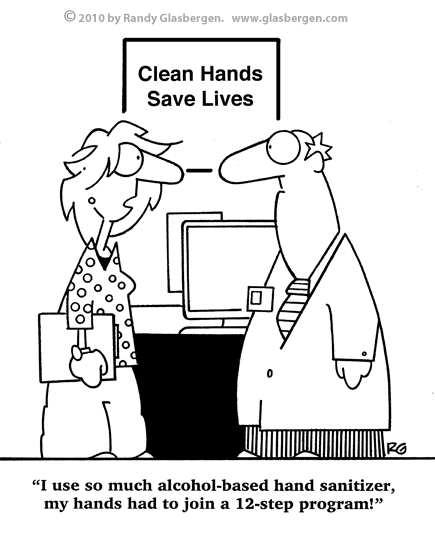
The first thing to comment on is a class procedure which has changed: The first thing my students do when they come into the class is to wash their hands with the anti-bacterial gel soap, a dispenser of which is on the wall at the entrance to the class. Bizarre, eh? One of the things which has always troubled me in schools is that, in a computer-heavy subject area like mine, cleaners NEVER touch the computers, keyboards or mice. And with the iPads' arriving, they certainly wouldn't touch those! (There is always the excuse that they're "not allowed to", but I can't honestly see it being likely that the person in charge of cleaning services is telling their staff any such thing). And kids, let's face it, are snotty and prone to poor hand hygiene. Some of you may be laughing at how remarkably understated I'm being on this matter... Anyway, I reckon that if you combine their hygiene habits (or lack of them) with the sharing of computers and iPads between 5 different classes every day, chances are you'd be able to account for a good 30% of the bacterial transmission within schools! And seeing as Dave Brailsford reckoned there were marginal gains to be had in keeping his cyclists healthy by using simple hygiene methods such as that outlined above, well, I decided to go for it. And I know this is anecdotal, but frankly the levels of attendance in my classes this year have been especially good amongst the classes using the iPads. Go figure. So, change number one: Hand gel at the start of every class.

Change number two: Organisation. We were very fortunate last term that SLT agreed to increase the number of iPads in the department to a full class set, with a charge/sync case. This has made the organisation and distribution at the start of classes a whole lot easier. All iPads were previously numbered, and allocated to individual students in each class, but what was numbered was the screens, so we still had a faff and a half opening them all and giving them out. Now, the sync case has numbered slots. Students know which iPad is theirs immediately, and where to put it back to charge at the end. 30 second procedure, including getting the ipads on. So far we are less than a minute into the lesson and students are ready to start. As opposed to the old Windows machines on the network which necessitated at least 10 minutes of "Bell work" before they were up and running and logged on. (The inverted commas around "Bell work" are there so you will recognise what I'm talking about, because I've re-christened it "Waiting for my f***ing computer to load, connect to the network and log me into all the correct drives work"). So, iPads definitely winning in the organisational stakes.

Change number three: Flipped learning: I'd always been a fan of flipped learning, the idea of setting learning for homework, and its application as a class activity which could be easily differentiated on the basis of how well the homework had been understood. The iPads have made this incredibly easy. The learning is set, and as soon as the students come in, the Socrative room number is on the board. The students now know to simply go to the Socrative app, enter the room number, and their quiz for the day will come up. If you haven't seen Socrative before, it is a web-based app which can be used on any device which can connect to the internet. Frankly, it's one of the most useful AfL tools I've come across. Look, I've even done a video tutorial for you here, and to the right, so now you have no excuse.

A few seconds after they've finished, I get email results telling me who has done well and who needs a bit more help (and who didn't do the homework at all!), and I can set them differentiated tasks or personal interventions to help them progress from whatever stage they are at. For example, yesterday we were analysing the front pages of magazines to see if we could work out what persuasive devices were used on audiences, and thereby identifying target audience characteristics. The class responses on Socrative clearly indicated that the class feel into four groups: The first set of responses clearly hadn't done the homework, so their first task was to do it to catch up (they re-take the quiz to prove it). The second group had not grasped a lot of the technical terminology in the homework, but understood the basics, and therefore they were given a cue sheet with definitions via dropbox to look at, to refer to during the analysis task. The third group did fine with definitions of key terms, but had struggled with the more open questions I'd set to test their application of the terms in analysis: They were also given a cue sheet of definitions (in case that was a problem but they'd guessed the vocabulary correctly in the test), but these definitions were a little more complex and used more media terminology, and also asked some key questions related to text analysis. I put these students in a group together to see if they could answer the more complex questions, and would then intervene more personally to answer their questions if they weren't sure. The final group had clearly understood their homework. They were given a set of additional questions to extend their thinking about the magazine techniques and get them to relate these explicitly to the target audience, and the sorts of gratifications they might get out of the magazine.

Although each group has been set off on different tasks because of their different starting points, this makes it easier for me to give them more individual attention without stopping the whole class, but essentially they are still working towards the same analytical task, just at the pace which is appropriate to their level of understanding. For the task itself, every group was then sent four documents: The mark criteria we had annotated into student-friendly language the lesson before, one model answer we had ripped apart the lesson before with the "What Went Wells' and "Even Better Ifs" we had written next to it, and another model answer we had looked at which was a WAGOLL. The final attachement was an Explain Everything project pre-populated with the keywords they would need for analysis. When they got to the analysis task, students had to find a hi-res google image of a magazine cover of their choice, and import it into the Explain Everything Project. They then re-arranged the key words with arrows to point to the features they could see, explained the connotations of each techniques and its effect on the reader, and finally wrote a summary on a second slide explaining why these techniques might attract the audience the magazine was targeting (below).


About half-way through the lesson, I stopped the students who were on the analysis activity, and put them into random pairs using the app RandomMastr, an easy to use list randomiser which the students are used to: They can see the results on the board through the AppleTV, so they know I'm not fiddling the pairs. The students swap iPads, and then leave feedback for their partner: Two WWWs and two EBIs. They had the mark criteria to refer to, and were told that their EBIs must be improvements which would make the most impact on the other student's result. If they wish (and several of them often do), they were allowed to use the mark criteria to guess what grade the piece might currently be on. The students often take advantage of this as they know I won't issue grades until the piece is finished. Another great feature of Explain Everything which some of them use is the voice-over recording: Some aren't great at expressing their improvements in writing, and so for the feedback I allow them to record their points verbally for their partner to listen to later. Once feedback is given, the students returned the iPads to their owners, and got on with improving their own analyses. And apart from directing the traffic, it sometimes seems as if I don't do much "teaching" in the traditional, stand-at-the-front-and-educate-them fashion. I just intervene on an individual level, and students seem to think this is far more effective, personalised, and suited to their individual pace of learning.


At the end of the lesson, I take a quick pulse check using Socrative again. We sometimes spend a bit of time talking about individual weaknesses or areas for further research, and that will form the basis of the students' homework, but the Socrative pulse check allows me to work out what areas they should be focusing on, based on a single hinge question. Students also have the opportunity to ask me a question through Socrative, which I can answer if the hinge question hasn't quite made it clear to me what a particular student's area of difficulty is. The students are set up for homework, have set their own tasks, and hopefully know what they have to learn ready for next time. They will then export their project to Evernote or to email so they can see what they have completed so far, to remind them while doing their homework, and that's pretty much all there is to the lesson.

This is the sort of lesson which can be endlessly fiddled with, modified, and combined with other techniques. For instance, we have started using SOLO Taxonomy as part of the peer feedback mechanism with one class, who are getting into it slowly. Similarly there are different ways of giving formative feedback to each other, including some of @Headguruteacher's brilliant "Closing The Gap" strategies. The one thing I hope you'll notice is that I haven't really mentioned the iPad that much throughout the post, and that's as it should be as far as I'm concerned. The whole debate shouldn't be about the technology (which is why I won't be drawn on the iPad/Android/BYOD debate): The technology merely facilitates the learning, and for that, you use whatever works best. I have a couple of students who really struggle with Explain Everything, so they are allowed to do their analysis work on Evernote. I don't have a problem with that. It's just a tool after all...

Saturday, 8 December 2012

My iPad journey - Updated

Cards on the table: I've been teaching 17 years and have always been a huge fan of computers and their potential for learning. I'm not an ICT teacher, nor am I any more than a gifted amateur in the ICT world. I am not a geek, except insofar as I watch The Big Bang Theory. And love it. OK, I'm a bit of a geek. But I have some semblance of social skills, so I'm not sure it counts really.

My journey with ICT began with computers, always Windows, big Apple hater to be honest. Then the iPad came out, and I liked it. I liked it a lot. But it bugged the hell out of me the number of work-arounds I had to find for functions which would have been simple for a PC. As a media teacher, it irritated me that I had to wait until iPad 2 for a camera, but once I had the camera, it didn't take long before the iPad gradually rendered my computer almost obsolete. The iPad started as a replacement for computers, in the classroom as well as at home.

And so the iPad began to replace many PC functions in my classroom, as a simple swap. There were limitations, but more advantages than I'd thought. the "switch it on and it's on" facility (revolutionary, I know: Who thought that one up?) was a huge time-saver, meaning I didn't have to plan whole lessons around computers just to make switching them on and the 10-minute boot-up worthwhile, or introduce lessons with 20 minutes of board-work just to kill time so the damn things were ready to go. (Honestly, all the tasks were really useful, promise)

At the same time I started on twitter, where all my best ideas came from. More or less all my ideas, if I'm honest. I am not one of life's creative thinkers, it's fair to say. But I do have a much under-estimated skill of being able to look at things which are beyond my creative capacity and give them a slight tweak to improve them. This was more or less how I treated most of my PLN's contributions: "Like that, how do I make it work for me?".

Our school has been on a three-year drive to improve AfL, and this was brilliantly served by Socrative quick tutorial here if you've never seen it before), which had the advantage of being usable on computers and phones as well, useful for classes where we didn't have enough iPads to go round. In fact, it's the ideal tool for any BYOD environment too. I started realising that the iPads had loads of advantages, but these were often negated if you didn't have a device per person, so using web-based apps helped as I could supplement the ipads with conventional PCs. This was enriching the learning in my class, with a greater variety in my students' educational diet which was keeping them on their toes.
(

By now I was starting to see the creative potential of the iPads for making movies, podcasts, comic strips, posters etc. It started out as a solution to my attempts to "flip the classroom", buy allowing me to create simple tutorial videos I could set as homework preparation for lessons (Our Youtube channel gives you a few examples which you are welcome to share). I could even put them into Playlists so that the videos became more advanced, and students were able to go as fast in their learning as they wanted to, which was really useful at KS4 and KS5. Using the camera on the iPad and iMovie enabled me to make these short videos within half an hour sometimes, and as they are all online now, they are permanently there for students to refer to. Which means I've stopped repeating myself in class, a lot. Apart from the phrase "Do you know where to look for your answer?" which is getting trotted out more...

My own forays into creativity also showed me the iPad's potential for increasing the number of ways my students could respond creatively to tasks rather than just using them to find out information, browse the internet and write notes. Creation is perhaps the one area the iPad really has it over other tablets, as it has a huge amount of potential. So my students would be using creative apps to illustrate their learning, and this, I realised, was enhancing learning dramatically, by deepening the way the students were thinking, and really getting them to synthesise and apply the information in new and creative ways. Twitter and @Gripweed1 added more apps from a fabulous website of the week feature he does, eg Explain Everything, and the ways in which my students were able to demonstrate their learning continued to grow.

Explain Everything has been a great case in point, one which I am developing my use of consistently. At first it was me making tutorials, or explaining concepts for students. But after a while I started asking the students to use it to explain the concepts themselves. The beauty of it was that it allowed them to use pictures, labels, extended writing, but also make these into movies which they could produce verbal commentaries for. A lot of my students with special needs have benefitted from this new way of accessing and showing their learning, or boys especially who never quite get round to writing things in any more detail than the absolute minimum they can get away with. Tell them they can explain it verbally or make it into a movie and they're mad for it. Tell them how brilliant the answer is but they now have to write it in ten minutes for an exam response, and they suddenly realise that succinct writing is a skill they also have to learn. Importantly though, those who always thought they were not much good in class because their written responses got low marks now realise that the knowledge is more than adequate, and that the only obstacle to good marks is writing. Somehow, that seems to make the task of improving slightly less daunting to them.

Then the enhanced learning led logically into sharing our work. Students were so proud they wanted to be able to show their work to everyone, through the Apple TV, and to their parents. Students sharing their work with each other on Twitter has increased the collaboration in class dramatically, for a start. QR codes, tweeting, Creative Book Builder (another easy tutorial here for those of you who've never tried it), were my first steps into this curating work and bringing it together. Again, @Gripweed's app of the week showed me countless possibilities for doing this, such as Wallwisher, Edmodo, Scoop.It. And my eyes began to open to the number of different ways I could do that.

I ignored virtually all of them, because if there's a down-side to Twitter, it's that it can deluge you with too many ideas. But I had enough to fulfil the functions I was after, and it was clear that sharing work was having an additional unexpected effect: It was extending learning. What students were producing was changing, the way in which they were doing it was changing, and they were now learning outside the classroom much more. I'd been toying with flipped learning for a long time, but suddenly these tools made it not only possible, but also driven by the students.

So the next stage was to stop exploring too much, and sit down and rationalise things. I spent time thinking about the functions I wanted my students to be able to undertake using the iPads, and created a list: Mind-mapping, AfL, writing and recording, researching, demonstrating learning, sharing learning, creating posters, word clouds, videos, demonstrations, podcasts, revision, online accessible storage.
Here are the tools I used, for those of you with an unhealthy interest:

AfL - Socrative
Mind-mapping - Popplet, iThoughtHD
Note-taking and recording - Pages, Evernote, GoogleDocs, Keynote
Research - Safari, Skype/Facetime, Khan Academy, TED and TED-ED
Word clouds - TagCloud, Word Collage
Demonstrating learning - Explain Everything, Skitch, Timeli, VideoScribe, Creative Book Builder, iBooks, Apple TV
Creating - CeltX, Cinemek, Pinnacle Studio, iMovie, PS Touch, PS Express, StripDesign, Phoster, Flipbook
Revision - Quizlet
Storage and sharing - Evernote, Dropbox, Cloudon, iBooks, Twitter, QR codes

Way too much info, huh? Up until the list you were busy thinking "Wow, great, cool, I should try this!" And then this turned into those, and I can feel your enthusiasm waning with the immensity of the task! I've been there. I sympathise. I call it "My inspirational Twitter PLN hell". But here's the thing: To quote my favourite philosopher Lao Tzu, "the journey of a thousand miles begins with a single step". There is no minimum speed limit on this journey. There is only DO or DO NOT. So pick one app. Try it. When you've got it wrong a few times, try it some more, get the students to help you out, or find work-arounds, and get good at it. Embed it. And then add another, and so on.

And add in your other learning styles: Flipped learning works brilliantly with iPads, as does SOLO Taxonomy. As, I would imagine, does co-construction. It's only a tool after all, and there are a whole load of ways it can help you do your job more effectively. The final thing you'll discover on this journey is that, beyond changing how you do things, varying your educational activities, deepening the learning of your students, and extending the ways in which they learn, you will ultimately have empowered your learners to take charge of their own education. Which is technically, I reckon, Outstanding, is it not?

The process so far has taken me a year. I now have four classes using iPads most lessons, for a variety of tasks, and constantly coming up with new ways to learn. Sometimes I feel like a spare part, but it just gives me a precious second or two to sit back and smile to myself. Before I get back on their backs expecting even more!

Thank you. Once again, you've made it to the end of the post. Here's your cartoon... At least I'm getting more consistent with my rewards system, eh?