Showing posts with label future. Show all posts

Saturday, 10 October 2015

Well-being

I've read a lot of really good blogs recently about teacher well-being, and what a tough nut it is to crack. Depending on whether you come from a leadership point of view or a chalk-face view, you will have different interpretations of where the problems lie, and what the solutions might be.
@kevbartle talked recently about the tokenism of some approaches (free tea and coffee anyone?), or the tick-box approach we are often forced to adopt by external agencies who also want to be seen to be "doing something" to solve the problem. Surprisingly, none of them seem to work. Surprisingly.

For what it's worth, here is my contribution to the debate. I hope it gets to the nub of the problem:

The first given in the debate is this: The business of schools is to produce students who, be it through good exam results or just more ambition, self-respect and belief, are ready for the outside world. We are there to give them "life chances" in the jargon. In a utilitarian view of education, they are the product which feeds the economy, and the product has to be top-notch. From a more humanitarian perspective, students are individual humans whose contribution can improve society if we have done our job well.

The second given is that our job as teachers and school leaders is to deliver that. The ultimate needs of the students must come above our own. Unfortunately, this very often includes the needs of staff well-being, or the needs we may have as normal human beings to have a life. We have chosen a career which, if we let it, can degenerate into a massive black hole for all our energies.

In this context, my contention is this: If students are the products of the system, we are the craftspeople who shape the product. We, and I realise I am risking derision for my choice of words here, are tools. If you're happy for me to carry on with this analogy, it works like this: A craftsman chooses how well he keeps his tools. He can buy them cheap, use them until they wear out, and then just get rid of them. Or, as is the case with real craftsmen, you can look after them carefully, keep them sharp, and produce excellent work with them for a long time.

For me, the well-being debate boils down to this: As a school leader, do your actions contribute towards wearing the tools out prematurely or do they contribute towards keeping them as sharp as possible for as long as possible?

To make my point, under which of the two categories would you place the following activities?
  • Free tea and coffee at break-times
  • Creating support systems around the school (ICT, SIMS, First Aid, school comms etc) which just work reliably day in day out
  • A reliable and easy-to-use VLE
  • Time to meet in teams to plan lessons together
  • Audits of lessons, learning objectives, marking etc
  • Staff socials
  • Timetables which minimise split classes, room changes, etc
  • Timetables which give staff time to socialise and discuss daily problems
  • Setting up a staff well-being committee
  • Staff freebies, such as health insurance or discounts on well-being services
  • Thinking hard about any new initiative, and whether it adds to or distracts from the "main thing": Teaching and learning.
To me, anything which allows teachers to teach more effectively and more efficiently is a sharpening tool: Anything which gets in the way of that is blunting the effectiveness of the tool. Ultimately, that will have knock-on effects for the outcomes we produce as schools.


Monday, 17 November 2014

The perpetual anxiety of education

This blog post follows a series of events which have clearly contributed to its central idea: These events include (in no particular order), a summer holiday where I truly reconnected with myself for the first time in ages, a set of excellent exam results across the Faculty I lead, a first half-term which nigh-on wiped that feel-good factor out, a Middle leadership meeting that left me feeling the overwhelming weight of national educational change coming soon, a well-being meeting where we tinkered around the edges but never really got to the crux of the problem, and a graded observation which was Good (with some outstanding features) but didn't really reflect what I've been doing this year.

What I've been doing this year is mostly consolidating a range of pedagogical tweaks I've learnt, mostly thanks to Twitterati (@headguruteacher, @HuntingEnglish, @ICTevangelist, @jkfairclough, @kathydarlison85,  @hgaldinoshea and @ragazza_inglese to name a tiny proportion) but also some fantastic colleagues at my school, and formalising them into concrete lessons via our new FROG OS VLE (a school development area). The VLE has been useful in helping me get to a really deep level of flipped learning, which I've always wanted to do, to the point where I have several classes where some students are now lessons ahead of others, and really powering through the learning. It has increased the independence of a significant number of the most motivated and able students I teach, and at the same time highlighted just how teacher-dependent some of my least able are. It has also, frustratingly, pushed me back in pedagogical terms by preventing me from combining the VLE with all of the great things I've learnt from two years of working with iPads, because the two won't talk to each other. All of which is irrelevant to the actual post, but you need the context to see why this topic is important to me.

The feeling I have at the moment is a horrendously negative feeling that I hate, because I'm not that man. I see myself as a positive person, someone who leads by example and encouragement. But at the moment I feel like quitting. I don't feel that moving up the career ladder to leadership positions is the answer, but I'm not enjoying where I am either. And I can't work out why.

Except today, it hit me. Like an epiphany. A more bleeding obvious epiphany you will probably never hear, and I appreciate that the first sign of publishing this will be greeted by a chorus of "Duh!"s, but here it is anyway. It's called the Perpetual Anxiety of Education. It's the result of the Accountability Matrix. Yes, probably very similar to the one your heard about in the Wachowski brothers' film, but not quite as entertaining. It starts with targets. As soon as targets are formulated, your job is to meet them. Aspirational or not makes no difference, you still have to meet them. And as a teacher, you spend your entire year in this state of anxiety about students meeting their targets. This of course is exacerbated by senior management, who have the same worries, but spread across the whole school, and with often only indirect power to do anything about it: Hell with a side order of chips! The less control you have, the more anxious you are likely to be. Hence the plethora of "accountability measures" deployed in order to keep checking that everyone is doing their utmost to hit those targets.

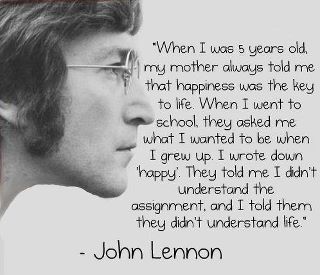
Copyright: Jantoo
As a teacher, this constant surveillance makes it very difficult for you to put it out of your mind, hence why I called it a perpetual state of anxiety. And there are few teachers who can do their job effectively without communicating this anxiety to the students. Thus the students themselves are also afflicted by the same perpetual anxiety. Ask the Year 11s in my mentor group who, despite my support and encouragement, feel this overwhelm from all sides. Because of course it's not simply teachers who are putting the pressure on, but parents as well. Are their kids doing as well as the others in their class? In their year group? In their school? What about other schools? Could we be sending our kids to a better school? What about the education system itself? Is it too soft? Is it "fit for purpose"? Is it really preparing my child to do career capital battle with that wiry, hungry little Singaporean kid I hear so much about in the papers, with his 25 hours extra tuition a day on top of his fifteen hours of regular school, per day...? Perpetual anxiety.

Now let's go back to this situation in schools. We have leadership whose job it is to deliver the targets, who have least classroom time to do it in. Their only weapons are by proxy, and they have to deploy these increasingly atomistic dictats to get the rest of their staff to get to "best practice" at all times: Do you have your MUST SHOULD COULD? Do your students know their targets? Their Working at Grades? Was the homework you set meaningful? Was it marked that day? Was it responded to in a meaningful ongoing dialogue which lasted until seconds before the exam? Did you push the students along at the perfect pace for them to cope while maintaining consistently high expectations etc? Don't get me wrong: This is NOT an anti-SLT rant, because I've been on the verge of going for these sorts of positions myself for a year or two, and the thing which has always stopped me is this very question: What would I do differently? You see, I think the vast majority of teachers and leaders are good people with the best of intentions, but these are too often warped by the target culture. The accountability matrix. What happens when you meet your target? That's a moot point to be honest. Because the vast majority of teachers only hit their target when the exam results come out. Even if you've hit them beforehand, the criticism is that you've under-estimated your target, you haven't been aspirational enough. So here's a higher one. But once the exam results are out, we have a week to celebrate the achievement of 51 weeks of anxiety-ridden stress, before 1) sending the students off to their next life stage, which will be even more target-riddled than the last, and 2) beginning a whole new round of targets of our own. Hamster-wheel, anyone?
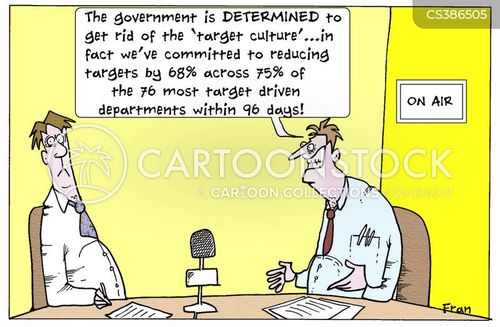
Copyright: Cartoonstock.com

And then we come to the staff well-being meeting. Where nobody can work out quite why staff aren't responding über-positively to the Friday morning cakes, the fruit bowl in the staff room, the staff silly jumper day and the disaggregated day off. These are drops in the ocean of a culture which is otherwise dominated by doubts about whether you could be doing that little bit more to hit those targets. The anxiety is the permanent, low-level background noise which defines the existence of many teachers on a day to day basis.

What's the worst thing about this state of perpetual anxiety? I'm not sure that this is just about education. There is a very good argument for saying that this pretty much covers the majority of our social ills at the moment, in a society which seems hell-bent on better and more rather than sufficient and happy. But I know which I would prefer if given the choice of how to live my life. And that's a BIG "if"...

Wednesday, 18 June 2014

In defence of Media and Film

I was quaking in my boots a little when OFQUAL published their list of subjects being considered for "reform" (or not!) a few weeks ago. And lo, there it was: Film is disappearing. One of the hardest, most engaging courses I teach, as well as one of the most enjoyable. Going. Going. Gone.

Those of you who follow these developments will know how this story goes: Two hours later OFQUAL rescinded their own publication, claiming that Film should not have been on the list (here if you're interested). Huzzah and hurrah. 

But then it struck me that, rather than feeling happy at this, I should have been more than a little indignant at the fact that we have to defend our subject's validity YET AGAIN! So I decided act, and to take their consultation document: For all the good it did. A series of anodine and difficult to disagree with statements which will eventually secure tacit agreement for the measurements they were going to take anyway, I suspect. So I wrote to them. This is my open letter to OFQUAL, in defence of Media and Film Studies' place on our curriculum.

To whom it may concern

I am writing to you about your online consultation concerning the reform of GCSEs and A Level qualifications. Having filled in the entire document online, I was disappointed that that the consultation document provided no opportunity to argue for the continuance of Media or Film Studies at GCSE, AS and A level, so this letter is a direct appeal in support of these subjects for your consideration in reforming them.

First, for the vast majority of the students I teach, Media and Film Studies are the most important subjects they learn, despite also studying so-called “traditional” qualifications alongside them. I teach in a highly academic school, and we do not teach for passes, we teach for excellence. Of the students I teach, seven in the past year alone have been nominated for national and regional awards for their Media and Film production work (including BFI Young Film-maker of the Year). I doubt that they would ever have achieved this level of quality of their own volition, without someone to introduce the subject to them in the first place through passion, rigorous academic study and through practical experimentation. These are the media and film professionals of the future, but they need time to master their arts. Students who arrive at university to embark on Media or Film as courses they are studying for the first time are at a clear disadvantage according to my former students, and the fact that mine have been training in professional skills since Year 10 means that one day, they WILL join the industries and move these industries forward innovatively and creatively, and keep the UK at the very top on international media and film production, with all that this entails for National economic growth and prosperity.

On an academic level, I would draw your attention to the already demanding nature of assessment: GCSE involves extended comparative writing which motivates many to improve their linguistic abilities; A level examinations are currently substantial essay-based examination papers. Both subjects include assessment of research skills, as well as analytical skills. These are the bedrock of the “traditional” curriculum we seem to be returning towards, so why would we withdraw subjects which reinforce such skills?

Second, there is a popular perception of Media and Film Studies as “soft” subjects, which I would disagree with fundamentally. The vast majority of my students will also tell you that Media and Film were far tougher courses than their “academic” counterparts. In part this is the fault of the mass media itself and its largely biased reporting of the subjects: The tabloids have no qualms about labelling our subjects as lesser subjects compared to the “traditional” subjects being pushed by the present government. The fact that the broadsheets put inverted commas around the word soft does not in any way absolve them of blame for reinforcing this perception, in my opinion. The message from the media is clear: Studying media or film is an easy option. 

However, I would argue that OFQUAL is equally to blame in this process for not countering this perception explicitly with evidence. I would contend that the level of demand at both GCSE and A level is very high: Students analyse film and media texts in exactly the same way as they do in English, except that they must take account of not only linguistic characteristics of texts, but also the way the layout, camera angles, editing and sound work in tandem with these linguistic features. This adds layers of meaning which are very subtle, additional to those studied in English, and indeed constitute an entire language of their own. And this only covers the textual analysis aspects of the courses. Film and Media Studies also require that students understand why texts are the way they are, by taking into account institutional, social, political, economic, historical and technological factors which may influence meaning and interpretations of texts. While this is a skill which is taught in English, I would argue that the up-to-date nature of film and media studies enquiries makes it much more challenging for students to interpret the influence of these contexts, as they are not doing so with the benefits of hindsight, or with the help of “expert voices” to guide them. Media and Film students learn a basic framework of analysis, but from there they are applying this to texts which are so new they are largely untouched by academic study. They have to apply their learning very subtly, often drawing in a range of material which benefits other subjects, such as History, English, Philosophy and Ethics, Sociology and Psychology.

Third, I would argue that the range of topics which are studied at GCSE and A level is also extending for students. The subject involves more than a study of mainstream popular film and media texts. It involves the study of texts from other cultures around the world, in other languages (my own students study Spanish, French, Iranian and Cantonese/Mandarin texts), and asks that we understand those cultures so as to be able to discern their influence on particular films, and their influence on our own culture. These are skills which are incredibly demanding for students between the ages of 14 and 18. Furthermore, film and media texts act as a cultural resource and a way of gaining access to experiences and cultures, and raising important issues relevant to society today (including, ironically, the idea of media bias and media agendas, and their influence on the political agenda, the reason that you are carrying out this consultation in the first place, one might argue: See point 2 above).
The media and film industries shape, and arguably construct, the terms of people’s perceptions, the way people think, their attitudes, values and beliefs. Students need to understand the role of the media in that process if they are to have any chance of becoming engaged, active and reflective citizens within our society. If we deny them these opportunities, we can only blame ourselves when society somnambulates into a future of fear, despair and obsequious conformity. We owe our students a better future than that.

I hope that you will give the above arguments the weight of consideration they deserve when considering how the subjects should be reformed.

Yours faithfully


Mike Gunn

If you want to write to them with your own equally passionate (but undoubtedly more eloquent) supporting letter, please feel free. The address is below:

Ofqual,
Spring Place,
Coventry Business Park,
Herald Avenue,
COVENTRY
CV5 6UB       


PS Rest assured: I didn't post cartoons with my original letter to OFQUAL!
                                                                                                             

Sunday, 11 May 2014

BYOD in schools - Part 6: Engaging parents

One of the most important factors in moving forward towards a roll-out of any form of mobile learning school, whether it be iPad 1:1, or BYOD in our case, is getting teachers, students and parents on board with the process simultaneously. Try shooting five basketballs towards a basket at the same time: It's more or less the same exercise. Or planning, teaching, marking, answering a thousand e-mail requests for paperwork and having any sort of life outside of school, for that matter.

I've dealt elsewhere with our general strategy and rationale for the roll-out , and looked specifically at the issues of staff training, student engagement in the process and the part played by Digital Leaders in this process, so forgive me if I don't revisit old ground here. We developed our strategy, worked out how we could train teachers gradually, and interviewed and trained our Digital Leaders to help us with our class trials. But now the big step to a whole-school roll-out looms, and we really need to get ALL of our parents on-board, or they won't allow their students to bring their devices in in the first place.

These are the key points we need to communicate to them, in my opinion:
  • They need to understand that this is not a gimmick to engage students: There is a clear educational rationale behind the move, which we consider will help improve the performance of our students on a long-term basis. In other words, they have to understand that our move is fundamentally about teaching and learning, and that the use of mobile devices in lesson will occur when there is a clear way in which it can augment, modify or redefine the learning in that lesson, and not otherwise.

  • They need to understand why we have decided not to specify a particular device (often iPads in these types of schemes), or indeed pay for the roll-out ourselves from school funds. Essentially there are two key reasons for this move, which are economic and pedagogical. Economically, we as a school cannot afford to pay for them ourselves (£70000 every three years?), and if we passed the cost on to the parents, many of them may not be able to afford it either, especially in times of recession, economic insecurity etc. So not only are we saving ourselves money (three more teachers potentially to help their students?), we are also saving them money, as 99.6% of our students already own devices which they probably bring in to school on a daily basis. Pedagogically, much as I am a fan of the iPad itself, I can't pretend that other devices are not catching them up quickly. Each new iPad seems less of an education game-changer than the last, and yet the premium is still charged. More importantly, I think there is real benefit to be had from giving students and parents the choice of what to bring in, and getting them to discuss issues of what each phone/tablet can and cannot do in the context of teaching and learning, rather than mere functionality (my graphics card is faster and bigger than yours, sort of thing).

  • We as a school need to address insurance worries head on: Many parents could quite reasonably object to their children being asked to bring mobile devices into school on the grounds that they could get damaged or stolen. But what if they currently allow their child to bring their phone into school at the moment? Then there is no change in the situation. The phones can still be insured as part of household contents insurance or, as many people already do, can be insured as discrete devices. Having said that, we as a school do also need to make it as secure an environment as possible for our students to bring their phones and devices to school safely. That means addressing potential areas where students might have to leave their devices unattended (changing rooms for instance), and ensuring that we are vigilant at all times, and have water-tight security systems in place to protect student property. To my mind, we should be doing that already. Similarly, in this new digital learning environment, we as a school ought to be pressing the insurance industry for easy, cheap and viable schemes which will allow us to protect our students' devices without costing the earth. Already, some financial institutions are beginning to respond to these requirements.

  • Finally, I think it is imperative that parents can SEE the enhanced learning which occurs as a result of using mobile devices. They need to see it in action: We should be inviting them to watch model lessons with students, with a debrief showing how it has enhanced the learning, the students' organisation, their motivation and the differentiation which devices can enable. They need to see these enhancements to lessons in order to understand just how much difference mobile learning can make to their child's education. If we can accompany these sessions with Q&A at the end, with both the teacher and the students involved, (as happened here when I taught a lesson in front of colleagues from across the city using the same techniques as part of a rolling programme of CPD observations "for real"), then I think parents will be a lot more positive about the use of mobile technology as an integral part of their child's learning experience.
My ideal way of organising this would be as follows: A festival of mobile learning. As part of this, the school would perhaps need to be open a day at a weekend (and perhaps have a day off as recompense?), and invite parents and members of the local community in to see a variety of activities in action. We would have different subjects running workshops on some of the ways in which they use mobile technology as part of teaching and learning and explaining how it works in an open session for all students and parents. We would also have several "show" lessons occurring simultaneously which parents could visit, look at the teaching, look at the types of activities students were undertaking, and talk to both students and teachers about how exactly the mobile devices are enhancing teaching and learning. You could even invite local companies connected with mobile devices and mobile learning to come in and sponsor the event, and use it to pitch the benefits of their products to parents, showing them the possibilities.

A fundamental building block of this strategy would be the involvement of students who already use mobile learning, and Digital Leaders in particular. Alongside the teacher-led workshops and model lessons, the student leaders could lead "Genius bar" style sessions including videos of other lessons throughout the year, the students' own thoughts on mobile learning, and the advantages it gives them over other learners. They would be able to show how they themselves support the process in school, answer technical queries, and could also talk to parents knowledgeably about the different sorts of devices they have used, the advantages and disadvantages of each for different subjects, and they could blog about this afterwards so that this advice is permanently there for parents to refer to, with direct links from the school website.

One of the other things this type of festival would facilitate is for other teachers who are less confident about tech use in lessons (from other schools, or from within our own) to get the same information, to interrogate the possibilities for themselves, and to make their own first steps. This would be great CPD for all involved, sharing best and next practice widely, and also enabling schools like ours to clearly demonstrate our role as a support school to those in the wider community. In fact, I think it would be great to follow this up with an hour's TeachMeet at the end of the day for teachers to share their best apps and resources, divided into different categories (AFL, BFL, differentiation and personalisation, etc), so teachers can get what they want out of it. That would act as a great summary of everything which has been shared that day, and really send people away with lots to think about.

After an event like that, I think very few parents will be in any doubt about the school's rationale for using mobile devices to enhance learning, and I would hope that teachers and students would be enthused, and that the wider community would be able to see just what a forward-thinking institution this was...

If we don't engage parents, and show them the realities of modern education, and the potential mobile technology brings within that environment, we risk them not understanding what we are trying to do, and we all know where that leads...

Add caption


Sunday, 4 August 2013

Leadership secondment: a great experience

Those of you who have been following my blog over the last few months will know/have surmised/been told/have no idea whatsoever that I was seconded to our leadership team for the past two terms. I can honestly say it probably came at the worst possible time for me, with a colleague who had just left the department and not been replaced, having to take on their exam classes, dealing with some serious personal issues of a couple of colleagues and trying to be a decent father and husband (the last two have been more or less accepted as optional by my family for all but the month of August each year, but that doesn't mean I stop trying, or at the very least feeling guilty about failing!). By the end of the process, however, I would say that it was one of the most worthwhile professional things I have done in the last few years.

The reasons for this might be divided into two: The worth lies in what I achieved (which is open to debate) and what I experienced. The latter I think is the most important, especially given the paucity of my achievements. I'm sticking with it as the most important thing at any rate. So what did I experience?

1. The opportunity to organise a whole-school project

Anyone who has read the non-leadership-y blogs of mine will know that the other element I've been captivated by this year is the potential for mobile technology to transform learning. Because of what I'd been doing in the classroom, other colleagues and leadership were getting interested in what I was doing (or wanting to know how I could justify all the expensive iPads at least). Having discussed the potential of the iPads, and the way they were transforming the teaching and learning in my classroom, it was clear that this was a way forward which could really benefit the school, but as I've written elsewhere, we were in no financial position to afford a 1:1 iPad programme. The compromise, which actually turned out to be far less of a compromise than I would have thought, was BYOD.

The scope of the project itself was huge: It consisted of getting SLT and teachers on board, getting technicians on board and working out how to get the network ready, getting student involvement, getting Digital Leaders trained, and trying to manoeuvre a lot of different elements into place simultaneously which gave me a sense of playing twelve-dimensional tetris permanently for seven months. It's arguable that there is no better training for Assistant Headship than exactly this! The whole project is now an integral part of our next three year focus in school, on the personalisation of learning, so I will genuinely be able to say that I have had an impact on teaching and learning across the school which, by the time the project is fully rolled out, will have affected every single student's learning. When you're a middle leader trying to take that next step up the career ladder, this is often the missing link, the whole-school dimension, where candidates come up short.

2. The opportunity to lead CPD

I have rarely worked in a school where there has been such a relentless focus on high-quality CPD, and where the majority of it has been provided by our in-house experts. The BYOD project gave me the chance to lead some of the individualised training our school runs for its staff in order to develop them all as far as we can, and also offered me a chance to view the principles and logistics behind that training programme. For my part, I was able to deliver CPD on how teachers can make use of mobile technology in their teaching and learning, to provide high quality assessment for learning opportunities, and to give students a huge amount of choice in how they learn, and how they present their learning. The CPD I delivered also gave my CPD co-ordinator a good idea of how advanced these practices were, and she in turn gave me the opportunity to deliver similar training to other teachers at TeachMeet Brum (1 and 2) and TeachMeet Cov, as well as at the Coventry Teaching and Learning Partnership. These consequently provided me with networking opportunities with other far-sighted teachers, middle and senior leaders and exposed me more importantly to doubts and questions about what I was introducing which were both sincere and legitimate. By the time I'd gone home to reflect on those questions and obstacles, the planned whole-school initiative was beginning to become much more water-tight, and much less likely to fail. That kind of high-level scrutiny and collaboration has been really useful in formulating my ideas, and also in giving me the confidence that the ideas themselves are worth carrying out from the point of view of enhancing teaching and learning, rather than being just another "initiative". My best moment was when a friend who is high up in the IT industry told me (after a half hour grilling me about our BYOD plans) that he couldn't find a flaw or a gap in them. High praise indeed. For the first time in my career I don't feel as defensive, and I don't see criticism as a negative, but as an opportunity for reflection and growth. Again, a real benefit to my career, no matter which direction it heads in from now.

3. The opportunity to observe a high performing leadership team

The chance to see how a high performing team operates, and what characterises them, was another key learning development for me this year. I got the opportunity to see how this team was shaped by strategic thinking and planning, long-term plans, conviction that your plan will do the job and get the best results, constant checking of the data, digging for the detail and the stories behind it, a focus on excellence rather than initiatives, a daily togetherness and opportunity to talk about operational matters, weekly meetings which were purposeful, focused and always about how to get the best for our students.
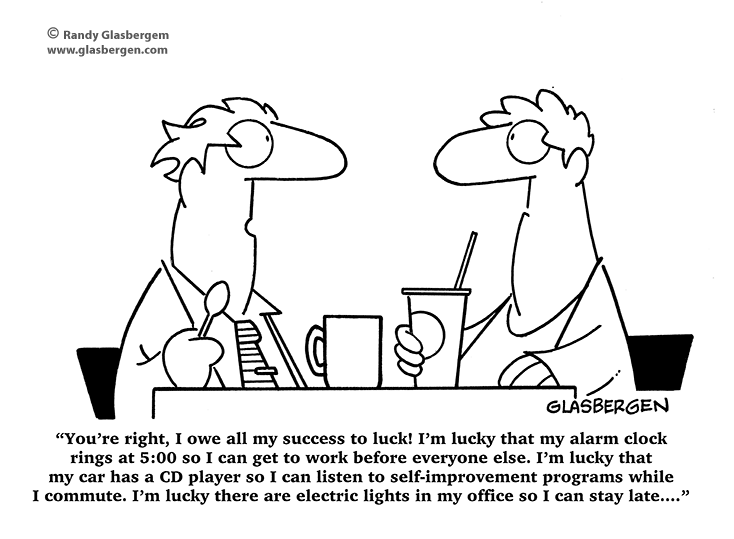
Copyright owner: Randy Glasbergen
I got to see that, while middle leaders and below often think of SLT as purely results-focused managers, they were actually focused now not just on the results, but also on the adults they wanted our students to become: There was review of the curriculum experiences of the students, their extra-curricular experiences, and the out-of-school opportunities we offer them. We spent time looking at different curriculum models such as the IB, the Middle Years Programme etc, and thinking about how closely the experiences they offered matched our aspirations for our children. Oddly enough, the current turmoil within our educational system served me well, as I got to see a team focus on the basics of the educational experience, and prioritise the things which really matter. I came to see that outstanding curriculum, teaching and learning, student experiences etc are never the result of accident or chance.

3. The opportunity to contribute

Within this context, I also had the chance to contribute to the above debates and see whether or not my own ideas stand up to scrutiny at such a high level. I think that's probably all I need to say on that section. They weren't laugh at. To my face, anyway. From my point of view, big win.

4. The opportunity to see how high-performing teams are forged

One of the most significant aspects of the secondment for me was seeing how high-performing teams are built and exploited to get the best out of each person. Like any good classroom, the team were divided differently for different tasks and projects, sometimes clearly in light of what they could bring to the project from their own expertise, but at other times to develop more latent skills which each member of the team perhaps needed to work on to become a more effective and rounded leader. There was a constant theme of support, and wanting to maximise the talents within the team, but also a feeling that they were constantly being asked to move forward, and become even better, even more balanced as individuals. What did I learn about myself within this environment? Well, apparently I've got some decent ideas. I have a focus on systems and strategy which will serve me well, but I also have a good eye on people, and hopefully won't ever put the systems above those people delivering them. Within a high performing leadership team, I held my own, hopefully, and would consider I had a shot at most AHT jobs. Having said that, you can probably see through the number of grammatical qualifiers and self-deprecations in the last few paragraphs that I haven't quite shaken off the demons of my own self-doubt. What I did get to see was that this isn't an entirely negative flaw, and that it also makes me a reflective person, which will again serve me well for the future as I try to grow professionally.

One interesting exercise we undertook as a whole team was a ColourWorks exercise, run by a company (ColourWorks, surprisingly) which asked us to answer a series of random and somewhat irritating questions and then presented us with a bunch of results about our leadership style. Considering how meaningless the exercise felt at the time I was doing it, I have to say that the results were stunningly accurate and insightful. I have  20+ page document at home about me and my leadership style from which neither I, nor any of my family, colleagues or friends have been able to fault more than about three statements. Interestingly, I am less gregarious in leadership than I like to think, and more reflective and logical. I am not pushy, or fiercely driven, and I always value consensus and people. As a result, I think I might be cut out for leadership up to certain levels, but not Headship. I am a good team player, and I can always help others improve their own ideas further, but I'm not necessarily a top leader. Perhaps it's a question of happiness or personal priorities: I find myself not driven enough by ambition to want to disrupt a work life balance which brings me great happiness and satisfaction as well as challenge. I'm not looking to be in a rut, I'm not wanting to coast: I genuinely want to be the best teacher and leader I can be, and to make a difference to as many students as possible. But I think at the very top you need a certain amount more self-belief and, let's face it, cojones, to take on those challenges and assume responsibility for everyone under you. One thing that does occur to me, however, is that someone like me, who doesn't allow things to get in the way of my own happiness, also understands how important this happiness and sense of personal satisfaction are for staff well-being as a whole, and that is an excellent attribute to have on any leadership team.

5. The opportunity to see where middle leaders fit in

As a middle leader I understand my function within the school much better now, and what opportunities I have to be able to help the leadership team by speaking up on matters whose impact I am better placed to understand than they perhaps are. This has also given me far more confidence to express those views, and I've noticed the same confidence emerging in others who have also had the same chance to undertake a secondment as I have. My bond with these people has now become much stronger as a result, and I can see that one of the points of offering secondments to middle leaders is to build this capacity for growth, self-discovery, development, and confidence. Similarly, from the leadership team's point of view, seconding middle leaders allows LT to gauge how broad or parochial the views of school issues are to those middle leaders, as well as how practical, feasible and strategic they are, so that when these middle leaders are consulted on matters affecting the whole school, the leadership have a good deal more faith in the feedback they get if they know the middle leaders in question can see things from both sides of the fence.


So in conclusion... 
  • I enjoyed the experience thoroughly
  • I enjoyed the challenges, and really enjoyed the whole-school responsibilities
  • I learnt an immense amount about how schools function, about how leadership works, and about myself and my own style of leadership
  • I learnt that leadership teams have real people in them too! And I learnt how to curb my natural tendency to bow in deference to superiors
  • I would recommend this to anyone, even if it's just to see what lies on "the other side of the fence"
  • If I hadn't been doing this on my full time-table, I think I would conclude that I might be able to manage a leadership job!
And finally, I would say I have learnt this, which I would like to pass on to all potential leaders, of the present or of the future:

Leadership without clearly defined core values, and aims which are consistent with these values, is nothing. Leadership without integrity is nothing. Leadership without reflection and questioning is nothing. Leadership without clear, consistent, transparent communication is nothing. 
There's a reason we are given twice as many ears as mouths, but once you're done using the ears, make sure that what you say is true, committed and strong.

Oh, and if any of you are thinking I could easily have describe Michael Gove here, go back and re-read the ears thing.

Now, who's going to give that job...?


Saturday, 22 June 2013

What's wrong with education policy debate

I am not prone to ranting. People who know me will tell you I'm neither confrontational nor particularly hard-line. I like to compromise, and find common ground. So this blog may seem out of the blue, and will eventually turn extremely controversial. You read on at your own risk.

I have several problems with current educational policy, but before you start accusing me of party politics, I would say that the political interference in education by Left or Right is equally bad, and that we ought to aspire to educational aims which are based on future-proof principles, and not constantly vacillating back and forth at the whim of the latest cabinet minister who wants to "make his mark" and stake his claim as the next Prime Minister. Seriously, is that a good basis upon which to decide the future of hundreds and thousands of children?

Current education policy does, however, seem to me to take the biscuit. It often seems formulated on the basis of very little evidence, which is in turn often flawed (remember the farcical uncovering of the "poor historical knowledge of modern youth" which was based on surveys for Premier Inn and the Sea Cadets?). Nevertheless, if a conclusion can be turned into a mantra and repeated frequently enough, and exaggerated further by the press who are looking to arrest their declining relevance in society (i.e. sales), it becomes the truth, does it not? This, in my opinion, is no way to conduct a debate about the nation's education.

To illustrate my point, let's turn the tables a little... What if we as teachers behaved in the same way as the education debate is being conducted?

What if we... told our students just to make one point in an essay, repeat the same point ad nauseam, and put it in capitals to make it more convincing and OBVIOUSLY true?
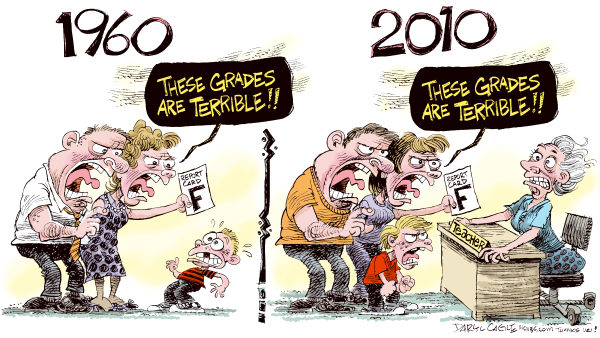
Copyright: Jim mentalindigestion.net
No, we tell them to evidence everything: Point, evidence, evaluate. We tell them to look for potential counter-arguments so they can see both sides, and then to evaluate for themselves what they think the answer might be. Memorisation of facts is not nearly as powerful as the ability to analyse those facts, take them apart, and find out the truth. Unfortunately, in the current climate, the truth, and the evidence which might prove it, and the nuances of the debates, are all simply collateral damage in the quest to gain political capital. What grab the headlines are not the measured nuanced debates of professionals, but the daily kickings from the Secretary of State and Michael Wilshaw which appeal to the confirmation bias of the 40 plus generation who read these things and nod sagely about how much better it was in their day (Was it really, by the way?).

What if we... started telling the whole class off when the naughty child at the back starts making too much noise? And then went out into the playground and started telling every who will listen that everyone was just as bad as that naughty child? Which of us has not been told that this is the first thing you never do in teaching? And yet the journalistic tendencies of making sweeping generalisations from those at the top is remarkable. I'd contend it's not appropriate for education, though. And one of the ways in which citizens would know that is if they had been trained in media criticism, such as is the case in Media Studies, and taught not to accept things at face value. Oh, but it's one of the subjects Michael Gove wants rid of. I wonder why? The journalist is someone who knows a lot of things superficially, and then claims the mantle of the expert. But the very nature of journalism is that it flies from one subject to the next so quickly that 1) it does not develop true expertise, and 2) it looks at things from the skewed perspective of what will sell/scare/interest/amaze the reader rather than reveal what is necessarily true. And these are just the good journalists. As we all know, there are plenty more in the industry who are hacks who will be far less thorough in researching a story, and simply find a couple of provocatively different views from which to formulate a story, and then let rhetoric do the rest. Did you notice I did that myself at the start of the last sentence? Clever and subtle, isn't it? This is how Gove and Wilshaw are winning the battle of the media day by day, and unless teachers fight fire with fire, and can convince the news media that there is a genuinely interesting story to be had in the misuse of statistics and in the manipulation of data for political and commercial ends within education, then we may well be doomed to lose the debate.

Clearly education must be failing: It says so in the papers. Despite the fact that OFSTED's latest data  on inspections puts around 70% of schools as Good or Outstanding (not all under the new framework, to be fair). We have a major problem in education: Again it says so in the papers. Every day. Last week we were (collectively, all of us, remember?) responsible for failing pupil premium students, the higher achieving students. Oh, and we were responsible for the rise of the EDL. The problem has been identified, and repeated again and again, so it must be the problem to focus upon. Privatisation of education has been identified as a key solution, as well as making everything harder. That will automatically tell us how to do our jobs better.

Let's look at this situation in a little more detail. A perceived problem has been identified, repeated forcefully and often: People who disagree have been demonised (anyone else an "enemy of promise"?), and we have been told that these enemies threaten our very future. This sounds almost exactly like the way newspapers create a moral panic, and for exactly the same reason, to inspire the feeling of trust in a protector who is looking out for us. You can see where any sense of nuanced debate is being lost here. As for the solutions, clearly privatised schools would not fail: Private companies never fail. And harder exams will obviously inevitably lead to better outcomes, despite the fact that teachers are not being told how to get their students to achieve these higher levels of attainment.
Indeed, if you think about it, how can we possibly get future students to be cleverer when half the profession are a product of the declining educational standards of the last twenty years?

What if we... scared the hell out of our students about their future, and then told them to do everything we say and that will get them home safe and sound? Like sheep.

So here's the controversial bit. Having worked incredibly hard for years to raise my own game as well as that of my students, the last year has coincidentally seen me think seriously about quitting this great profession several times. The egotist in me asks why on earth I should let politicians force me out of a profession I love and am, as an outstanding teacher apparently, quite good at. But then I started thinking of the other people who've probably had similar thoughts.

What if we, as a profession, quit en masse?

Not going on strike. That makes us easy targets to demonise. Governments are great at getting the public to turn against anyone who inconveniences them. But actually quit. Said "We are not prepared to participate in an education system which we believe damages the future of your children, and decreases the life chances of a significant number of them. Find someone else to teach what you want taught."

So far, I've had a variety of gut negative reactions to that suggestion, including my wife's. Gove isn't forcing me to quit a profession I love, goes the line. Except you love the ideal of the profession, not, very often, its actual current substance. We teach despite the fact that we don't like the direction. But then I would argue we are more or less complicit, or at the very least placing ourselves at the mercy of the whims of each Secretary of State. We have long talked about the depoliticisation of education, and even Mr Gove himself has alluded to this as a noble aim of his. But do any of us seriously believe he has that intention?

So I go back to my point. Quit. What would happen?

First, if Heads and teachers quit together, we could not be blamed for holding the nation to ransom. The Secretary of State can simply replace us. In a year, when new teachers have been trained. Oh, and since most PGCE courses have been replaced by in-school training, who is going to do that training? And who's going to do the appointing? I seem to remember the Khmer Rouge getting rid of all Cambodian teachers because they were bourgeois professionals who undermined the Marxist revolution. The effect was catastrophic. Parents are not going to like the fact that their children have nowhere to go. But we aren't withholding our labour: We quit. Perhaps parents after the initial anger directed towards those who have inconvenienced them, would want to know why teachers would actually be prepared to leave their jobs because of the Secretary of State's policies? Maybe then we'd have slightly more informed debate on the subject, and the public would demand our reinstatement?

Maybe I'm an idealist.

But I'd rather be an idealist than a collaborator who fears there is no other option. There always is. And the vast majority of answers I've had about this, while intelligently rationalised, have always been reactions of personal fear.


Sunday, 2 June 2013

BYOD In Schools - Part 4: Student Engagement

This year has seen our school begin the process of implementing a Bring Your Own Device Strategy (BYOD) across the whole school, notionally led by me, which is somewhat worrying. Fortunately my erstwhile co-leader @Gripweed1 has made up for my many deficiencies in the process, and we enter the final half-term of the year, 6 months after starting, having successfully negotiated the first stage of the process. I've blogged about the different parts of Stage One before, but a quick recap may save you trawling through all that:

We started by mapping out the route we would take, looking into other schools which had gone down similar or alternative roads, and identifying areas of planning and infrastructure issues we had to address first before moving forward. We then began involving students with @Gripweed1 leading a highly successful Safer Internet Day, where students were consulted about the rights and responsibilities of them being able to use their own devices in school as a learning tool. Their input was critical in allowing us to develop a BYOD policy, and the intention is to have students review this annually as part of our PHSE programme, to ensure it remains up-to-date and fit for purpose. While our focus shifted on to a small group of "dangerous teachers" who were conducting class trials with the students, we realised that the students were going to be the key to the success or failure of the whole process, and it is this student engagement I want to address today.

So far, we have engaged different sections of the student community at different levels. All were involved in the development of the Acceptable Use Policy, and several classes across different year groups have been involved in exploring the technologies through trials. Now we're looking at the issue of digital leaders, and the contributions they might make to moving the process forward. There is a great deal of talk across the Twittersphere about digital leadership: Some of it is little more than a nod towards it, as I've seen in several schools where student leaders are more or less teachers' assistants. However, there are many other schools where it is clear that students are genuinely leading not just other students, but also the teaching and learning process through mobile technology, and here they seem to be driving the idea forward almost more effectively than if the process were top-down. Mark Anderson (@ICTEvangelist)'s work at Clevedon in the South-West is a case in point, and we have learnt a great deal from his generously shared expertise.

Our initial discussions for the roles of digital leaders looked at a variety of potential roles Digital Leaders could undertake. These ranged from having

  • FROG champions who would train students and teachers in the use of our FROG VLE
  • Technical support leaders who would almost be apprentice technicians 
  • E-Safety Specialists whose job would be to advise and monitor e-safety across the school
  • Device Specialists whose job would be to look at the way certain device workflows could be translated to other devices without causing problems 
  • We even then started thinking about having specialists in different types of software as these need considerable training too, for example Adobe specialists, Microsoft Specialists, Android Specialists etc

You can see that the lists eventually became far too cumbersome to be workable! We were ourselves in danger of losing sight of "the main thing" and turning our digital leaders into glorified Techies, so we changed our focus back to Teaching and Learning, and this proved far more fruitful. All aspects of the role can now be clearly related back to leading, enhancing or supporting teaching and learning, and we have also looked at how digital leaders can be used to smooth the transition of students coming up from primary schools so that they are confident and ready to meet the challenges of secondary. Equally, we would like Digital Leaders to be able to use their experiences to gain accredited qualifications which would help them further a career in this sector if they so wished, and we are currently exploring the sorts of qualifications on offer.


This is what we came up with in the end...

Digital Leadership at Finham Park

Job description

Digital leaders will...

Be able to support teaching and learning through SMART Learning
Be able to support the use of mobile devices by teachers and students
Be able to support and develop the use of VLE
Be able to assist specific departments with the acquisition of teaching and learning resources (apps, websites, software)

Be able to develop outreach programmes
Be able to liaise with primary schools to promote digital transition
Be able to manage the digital leaders' social media presence
Be able to work with collaborative networks in order promote and share best practice

Be able to support the development of e-safety training across the school
Lead assemblies to whole school on e-safety
Lead lessons to students in e-safety
Lead whole staff training on e-safety
Be able to promote the use of digital technology at whole-school events (e.g. Genius bars at Year 7 parental events)

Be able to offer basic technical support to teachers and departments
Checking computer power, peripherals, sound, mice and keyboards
Helping teachers to use iPads with AppleTV
Clearing a printer jam
Checking toner and paper
Projectors and connections
Problem diagnosis?
Management of school computer screens, uploads and podcasts
Preparation of machine images through FOG
Device usage (ipads and other devices, especially help for staff)

Person Specification

Digital Leaders should...

Be dedicated to this single area of student leadership (there are many other areas of student leadership around the school, but we feel this role is so big it will be time-consuming)
Be a positive role model to other students
Have an interest in developing digital technology skills further
Be responsible users of technology
Be keen to learn to work with other people involved in the creation of a digital environment
Show tenacity and commitment
Be able to demonstrate prior digital skills
Have a clear understanding of safe and responsible social media use
Be willing to foster leadership skills

Our second draft of a job description has yet to be approved, so I put it out here for discussion: Have we missed anything? Can you help us to tweak it further? If I've learnt anything from blogging and tweeting, it's that no idea I've ever had couldn't be improved by somebody out there, so we very much welcome any input here via the comments section below.


The class trials will report back at the end of the year, and hopefully we will have enough evidence that mobile technology can have a tangible impact on teaching and learning to move the project forward across the whole school. At this point, the role of the digital leaders will become crucial in the process, and it is more than likely that they will be leading teachers as much as students. This gets us to a stage I think many schools and SLTs are nervous about, namely where the students' expertise begins to overtake that of the staff. I can empathise with this to an extent, although I have to say that mobile technology is one key area where, if teachers don't learn to step outside of their "sage on the stage" role, we won't move forward very fast. As an old t'ai chi teacher of mine once told his students, "if I don't train you with the aspiration of becoming better than me, who then will I learn from?"

Only if we can get over this psychological obstacle in how we see our role will we truly begin to create a collaborative learning environment, where teachers and students move each other forward.

http://ui.asu.edu/blog/wp-content/uploads/2010/06/cartoon1.jpg


Sunday, 26 May 2013

Unfettered Leadership - A Thunk


Quick mini-post today. Forgive the fact that it wasn't just tweeted, but I thought that the quality of responses would be better from comments rather than tweets.

There has been much inspirational talk over the past week by the #Vision2040 group about the future of our schools, the direction of the curriculum etc. I started a bit of blue-sky day-dreaming about how I would run a school if there were no shackles, and then realised how hard it was to come up with concrete answers. Lots of platitudes and generalities and the like (I'm good at them!), but nothing very specific. So in the spirit of thunkage so popular on Twitter, what I want to know is this:

If Michael Gove was to de-politicise education entirely, including his present accountability systems, and you had free rein to do as you liked in your schools, what EXACTLY would you do or change?

Answers in the comments section please. I REALLY want to know what you would do...


Saturday, 16 March 2013

Making Learning Irresistible


Mick Waters
Making learning Irresistible

Last  weekend was my first experience of the Coventry Learning Partnership Plus conference, and unfortunately I didn't really get the full flavour of all the excellent workshops going on because my school volunteered me to run one! What I did have was the privilege of hearing Professor Mick Waters talk to us on the Friday night about making learning irresistible. He talked for 90 minutes. It barely felt like 10.

I talked to several people afterwards about what they'd taken from the speech. We were all inspired, but could we put our finger on what exactly the thrust of the talk had been? Could we hell! This blog is my attempt to try and draw some conclusions from what I heard, and summarise where Professor Waters thinks we should be heading in education, a direction I have to say from the outset that I whole-heartedly agree with.

By way of personal context, there has been a lot of talk in our leadership team at school about the role of character in a child's education, about teaching more than simply content, "subjects", and even learning skills. Our current education system seems intent on reducing the really important things we teach our children to lip-service, as it is perhaps not deemed to be measurable, valuable or, dare I use the jargon du jour, "rigorous". This isn't a party political point, as I think the last government's focus on targets, attainment etc are equally blame-worthy in this respect. And nor am I saying we shouldn't be accountable for our results. I am simply arguing that our present focus on what can be measured has created an unhealthy obsession with those things over the other important areas of our educational remit, namely to help students to discover who they are, what they can do, to foster their curiosity, to nurture their talents and interests, and to get them to understand how to accomplish their goals meaningfully in a way which is as beneficial to society as it is to them. Children who care, rather than children who spend, perhaps. Though I'm told this is bad for the economy. By which of course we mean the rich folk at the top of it. Moving on...

Professor Waters' starter for the ten is the contention that, in order to prepare for and learn about the outside world, the UK for some reason corrals students behind a fence, in institutions where we actually ignore and fall behind the real world all the time. We are obsessed by the need to get on, get through the content, and miss out on the chance to make things come alive. In our efforts to have our students undertake "meaningful" activities all the time, while taking the register for example (we make them do planner checks, numeracy activities, give them tonnes of information etc), we fail to realise that the real world is always there to be tapped into.

Our focus on results has another very negative effect on students: We label them. And we label them in a way which stigmatises them deeply, despite the fact that what we are labelling is transient. One child can't do equations yet. Another has difficulties focusing at a certain time of day. Another can't get to grips with a couple of particular subjects, so we label them "Not achieving 5 A*-C grades"! Here's the thing though: If you were to grade yourself in different subjects at different times, how would you fair? On a scale of Outstanding to Unsatisfactory, how would you rate your own abilities in relation to gardening, decorating, writing, taking photographs, playing an instrument or learning a language? I imagine few of us would be excellent all-rounders, but that's not to say we don't have serious talents in one or more areas: Just look at Einstein. Bit of a failure in school by all accounts. Likewise, students are at different levels in different subjects at different times, but our need to measure things makes it easy for us to focus on the numbers and not the child in front of us. Do the numbers really tell the story? Oddly enough I was listening to a Radio Four business programme the other day where several chief execs were agreeing on this very point, and saying that the data they got on their desks every day was a deeply inferior diagnostic tool compared to direct contact with their people on the ground floor and their customers. A lesson for us all perhaps...

So back to the students: Most of us start out positively in school, but even with the best of intentions, because we can't invest sufficient time to master a skill to the outcome level we want, we end up as "disillusioned triers" who give up on our ability to learn it. Waters does a great experiment with kids: He asks them how they would rate themselves in all of their school subjects. Apparently you never get more than 40% say they're any good at something. But if you ask them about how good they will be at driving and learning to drive, and whether they'll be any good as drivers, they respond overwhelmingly positively. About something they've never tried before. Is it the learning experience which puts us down, or the labeling which occurs along the way?

Similarly we could ask as professionals whether a teacher whose lesson is described as "satisfactory" is actually a satisfactory teacher? Or is this just a label? A snapshot. Under pressure too. Like a terminal exam even. Strikes me as a bit unfair to judge us this way on an annual basis, never mind judging a whole school every four years using that method. But boy do we bust a gut to get the "Outstanding" label! Professor Waters' conclusion was that the Outstanding teacher teaches good lessons consistently, but more than that: He or she also looks after the lonely child in the corridor. Is the latter any less important that the former? Are the teacher who have left a life-long impression on your lives the ones who taught tight formulaic "Outstanding" lessons every day? Or the ones who cared? Who took the time to listen to you? Who took a genuine interest in you as a person?

Many Outstanding schools are outstanding because they follow "the trudge", and they do it well, and have hit the right formula. The relentless focus on "5 A*-C grades", "RAISEOnline", CVA, the systematic monitoring, the countless interventions: All of these serve to get as many students as possible over that finish line which the data says they should cross, based on mathematical probabilities and algorithms we shouldn't question because they're far too complex for us to understand. And then they suspend the timetable for a day occasionally so that they can do a whole-school activity which will provide the rounding out of their characters (!) which society also requires. Are we really delivering that? Not according to Mick Waters', industry, the government, the parents or the Daily Mail!

A futures learning outlook

What we really need is to focus on what we hope for our students. The government is more focused on the core of knowledge, but we should be producing rounded human beings, and enthusiastic, curious learners. An outstanding teacher's role is to raise the spirits and self-esteem of their students, and to raise their gaze so that they look up at the world around them and see themselves as part of it. Our role is to help them find out who they are, and how they can make a positive difference to the world, and find a sense of their own happiness within the roles they choose for themselves. Our curriculum should be based on the big questions, with students clear about how the small matters fit into the bigger picture. It should prepare them to tackle big questions, and connect to the real world every lesson. Every child should be able to see the relevance of lessons for life in the big wide world as it is today. But I would suggest that this is just one aim. The second, and more important one as far as I am concerned, is this: If we start by showing students how their learning connects to the real world as it is, we should also be fostering the kind of curiosity and thinking which will help them shape the society that we could have. Because demonstrating to students how they could fit into modern society means we implicitly accept everything about that society, including its values and priorities. And I for one think that this demonstrates a real paucity of ambition. I would hope that our children can do a better job of society than we have. But it's unlikely to happen if we persist in telling them that what we have now is the only way it can be done.


The best summary of this perspective I've ever seen was written by a man named Kahlil Gibran, in a brilliant book full of wisdom call The Prophet. Given the daily vacillations in education policy and debate in this country, these thoughts help to anchor me as a teacher and a parent.

Your children are not your children. 
They are the sons and daughters of Life's longing for itself. 
They come through you but not from you, 
And though they are with you, yet they belong not to you. 
You may give them your love but not your thoughts. 
For they have their own thoughts. 
You may house their bodies but not their souls, 
For their souls dwell in the house of tomorrow, which you cannot visit, not even in your dreams. 
You may strive to be like them, but seek not to make them like you. 
For life goes not backward nor tarries with yesterday. 
You are the bows from which your children as living arrows are sent forth. 
The archer sees the mark upon the path of the infinite, 

And He bends you with His might that His arrows may go swift and far. 
Let your bending in the archer's hand be for gladness; 
For even as he loves the arrow that flies, so He loves also the bow that is stable.